


The world was shocked early Wednesday morning when Donald Trump, America’s 45th President, became its 47th. In a campaign that pundits and pollsters routinely characterized as a coin-flip, Trump looks poised to not only sweep the seven so-called ‘swing states’ but to also end up securing a victory in the popular vote for the first time in his three bids for the White House. Republicans at-large are on track to secure a trifecta in controlling the federal government as a handful of close races are decided in the U.S. House of Representatives. Mr. Trump will have total control over the levers of power, with a permission slip from the democratic majority of America’s voters to pursue his ‘America First’ agenda.
The result is an unmitigated policy disaster for climate change and clean energy, the future of the Supreme Court, European stability, and the protection of minority and women’s rights at the federal level. It may also become an economic disaster, depending on how many (and how haphazardly) of his campaign promises Mr. Trump attempts to fulfill. If your social media feeds were anything like mine these last two days, they were full of progressive and liberal friends “disappointed but not surprised” that this has happened… again. Others were in full panic, dread, and despair, ready to “fight” and “resist” Mr. Trump’s democratically-given second term. Blame was quick to be cast on the Democratic Party’s messaging and Harris campaign’s strategy. More in-fighting, hand-wringing and soul-searching is sure to follow for America’s new minority party in the coming weeks.
But here is the cold, sobering, and harsh reality: at some point in the last 15 years, the Democratic Party stopped being democrats.
So far, little evidence exists that Kamala Harris’s traipsing around Pennsylvania and Wisconsin with Liz Cheney changed any voters’ minds. Ms. Cheney was formerly the third most powerful Republican in the House and is the daughter of former Vice President Dick Cheney — a chief architect of America’s misguided war in Iraq and boondoggle in Afghanistan — both of which cost thousands of American military lives and millions more civilian casualties. These ultimately resulted in the birth of ISIS and Joe Biden’s eventual withdrawal from Afghanistan, returning it to the Taliban the same as in 2001. Ms. Cheney’s involvement, often heavier than Harris’ own VP pick, is shocking for a party whose biggest star — Former President Barack Obama — was nominated primarily because of his staunch opposition to Ms. Cheney’s father’s wars. Now, as Mr. Biden is unable (or unwilling) to curtail Israel’s use of American-made bombs on Gaza’s civilians and as Mr. Trump has claimed victory partly on his promise of “no more endless wars”, the Democratic Party has somehow become the party of the military industrial complex. The party’s paltry imitation of George W. Bush’s Republican party, however, seemingly comes without any natural base of support from…Democrats.
Ms. Harris’ campaign began joyfully. She drew praise for picking a progressive blue state governor and football coach as her VP, eschewing other establishment picks and presidential hopefuls with Wall Street donor ties. Her running mate highlighted his free school lunch program, his climate actions, and his protection of LGBTQ and women’s rights in Minnesota in the weeks leading up to his selection. “Oh yes, I’m such a socialist monster, feeding kids so their bellies are full so they can go learn,” Mr. Walz said on TV. It was a good comeback to tired and constant Republican attacks that Democrats are “communists and socialists”. But then, the Harris campaign seemingly chose to never really highlight Mr. Walz's progressive credentials again. He barely mentioned them in his lone debate with Trump’s VP pick, JD Vance.
Instead, Ms. Harris’s campaign slipped into the same, haggard routine that had plagued the candidacy of Joe Biden: trying to convince Americans that electing Donald Trump would be the end of our entire democracy. She backpedaled her opposition to fracking to appeal to voters in Pennsylvania and promised to become “tough on illegal immigration” while running ads low on substance and high on fear. Mr. Trump, by contrast, also ran bombastic and untruthful ads but focused his swing-state ads largely on immigration and rising grocery prices. As has often been the case in his political career, Trump occasionally diagnoses a problem correctly and then offers the entirely wrong prescription to cure it. The version of the future he painted if Harris were to win the election was equally bleak and hateful, but ultimately more believable to the average voter. This election was the third in a row that national democrats have called “the most important in our lifetime.” Voters should be forgiven for not believing them, even if they’re right.
The Democratic Party must use this moment as a reflection point. Many have mistaken the core lessons from Mr. Obama’s successful campaigns in 2008 and 2012 to be that a highly “message tested” pitch and knocking on as many doors as possible is the secret to winning. Ms. Harris’s failed campaign, despite a ‘ground game’ arguably stronger than Mr. Obama’s, shows that not only do you have to reach the voters — but you have to have something positive to offer them when you do. It is not enough to just be against the other side. Your campaign must be inspiring and have soul. The message and the candidate must be authentic.
Democrats have controlled the White House for almost 75% of the last decade and a half. In that time, monumental legislation has passed, including a slate of progressive climate and industrial policy under Mr. Biden’s infrastructure bill and Inflation Reduction Act. But, in reality, despite 12 years of Democratic presidencies, I can think of one—maybe two— true changes that have trickled down to the average working class American’s kitchen table. The largest came in 2010 — nearly 15 years ago — when the Affordable Care Act guaranteed health insurance access for Americans with preexisting conditions. The policy became so wildly popular that Republicans were politically unable to repeal it when they last controlled the whole of government in 2017.
In this campaign, such vision was lacking. Where was a commitment to end violence abroad and find resolutions to the conflict in Ukraine and Gaza? Where was a commitment to protect U.S. workers from foreign competition and secure our supply chains against further disruption from China? Where was a bold proposal for paid family leave and universal access to childcare? Where was the even bolder commitment to advance clean energy development and enforce environmental regulations? Where was the coherent explanation for how Democrats would protect bodily autonomy and advance LGBTQ rights? Where was the plan for making social security sustainable and protecting retirement benefits? Where was the plan to continue to address the rising costs of healthcare? Where was the plan to actually bring down housing prices, expand supply, and help more Americans achieve home ownership? Where was the concrete proposals to close the wealth gap and address racial inequality in our economy and our schools?
These plans undoubtedly (hopefully) exist somewhere, either buried in an online platform or in the minds of Democratic policy advisors. But they were not highlighted and no path forward was coherently offered to voters. Over a billion dollars in campaign fundraising was spent to scare voters about Mr. Trump’s version of America rather than inspire them to support Ms. Harris’ vision.
What, then, is the path forward?
Democrats must become Democrats again. They must offer a positive and achievable progressive vision of the future to voters, and in particular to working class voters of all races and genders in both urban and rural communities. Calling a portion of working class voters racist and misogynistic isn’t a viable path to political victory. In fact, in the absence of inspiration, it is clear that many diverse voters in the ‘big tent party’ have grown curious about what might be on offer in the other tent. This is evidenced by Mr. Trump’s improvement in 2024 with some minority voters, young voters, and yes, women.
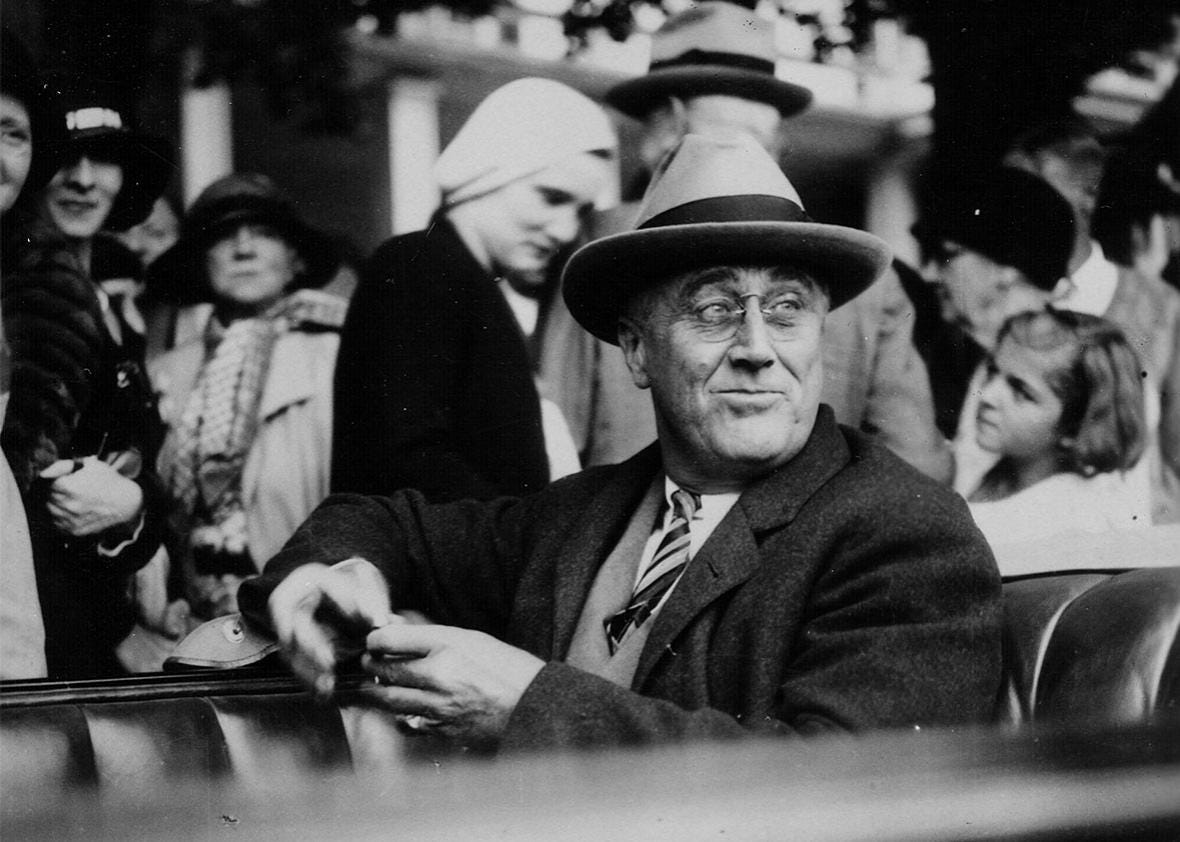
In 1932, when accepting the Democratic Party’s nomination at the convention, amidst a backdrop of economic depression and rising fascism and instability abroad, Franklin Roosevelt ended his address with this:
“Never before in modern history have the essential differences between the two major American parties stood out in such striking contrast as they do today. Republican leaders not only have failed in material things, they have failed in national vision, because in disaster they have held out no hope, they have pointed out no path for the people below to climb back to places of security and of safety in our American life.
Throughout the nation, men and women, forgotten in the political philosophy of the government of the last years look to us here for guidance and for more equitable opportunity to share in the distribution of national wealth.
On the farms, in the large metropolitan areas, in the smaller cities and in the villages, millions of our citizens cherish the hope that their old standards of living and of thought have not gone forever. Those millions cannot and shall not hope in vain.
I pledge you, I pledge myself, to a new deal for the American people.”
Mr. Roosevelt went on to occupy the White House for more than three terms as President and drastically reshape the federal government and American life. Democrats now find themselves in the position of 1932 Republicans. They must extend hope to voters, as Mr. Obama did, and “point out a path for the people to climb back to places of security”, as Mr. Roosevelt framed it. They must, like FDR, offer a true new deal to the American people in farms, cities, towns and villages. And they must do it soon, lest Mr. Trump’s vision of America continue to fill the void.