


Billions of dollars worth of clean energy projects have stacked up following the passage of the Inflation Reduction Act (IRA) and the Bipartisan Infrastructure Law (BIL) but one of the major bottlenecks has remained federal permitting. Even as huge investments are made in solar, wind, hydrogen, and hydroelectric infrastructure, we need to build new infrastructure much more quickly to carry clean energy across the country. But a new proposal in the Senate to speed up infrastructure permitting offers far bigger giveaways to oil and gas producers and will make it harder to regulate pollutants and hold companies accountable.
What is ‘permitting reform’ and why does it matter?
Transmission infrastructure is the backbone of the American electricity grid. You’ve probably seen transmission lines running alongside highways or cutting through stands of trees, supported by massive towers. These carry electricity away from wherever it is first generated to what are called substations (you’ve probably seen these too). Transmission lines run at high voltages over long distances. Once electricity reaches the substation, it is converted to lower voltages for distribution to utility customers. A recent study from Princeton University estimates that failing to grow transmission infrastructure faster than its current pace (1% per year) would cause nearly 80% of the emissions reductions promised by the IRA to go unmet by 2030.
Here’s the problem: building massive transmission infrastructure to carry electricity is extremely complicated. It’s complicated to connect new projects to the grid. It’s complicated to solve legal, environmental, land, and cost problems. It’s complicated to coordinate among multiple counties’, multiple states’, and the federal government’s regulations. And these complications mean that things happen slowly. Sometimes very slowly. Permitting reform is the term generally used to describe streamlining the complicated hoops that new infrastructure and energy projects must jump through before they can be built and begin operation.
However, permitting reform isn’t just something that Democrats want to expedite the new grid infrastructure needed to meet President Biden’s Inflation Reduction Act goals and combat climate change. The desire to speed things up has traditionally been bipartisan, but for different reasons and in different ways. Traditionally, Republican elected officials have pushed for permitting reform to increase oil and gas drilling opportunities, particularly on federally owned land and offshore sites. Republicans have also long been advocates for legal reforms, reducing the ability of energy projects—like pipelines and wells—to be challenged in court on environmental grounds.
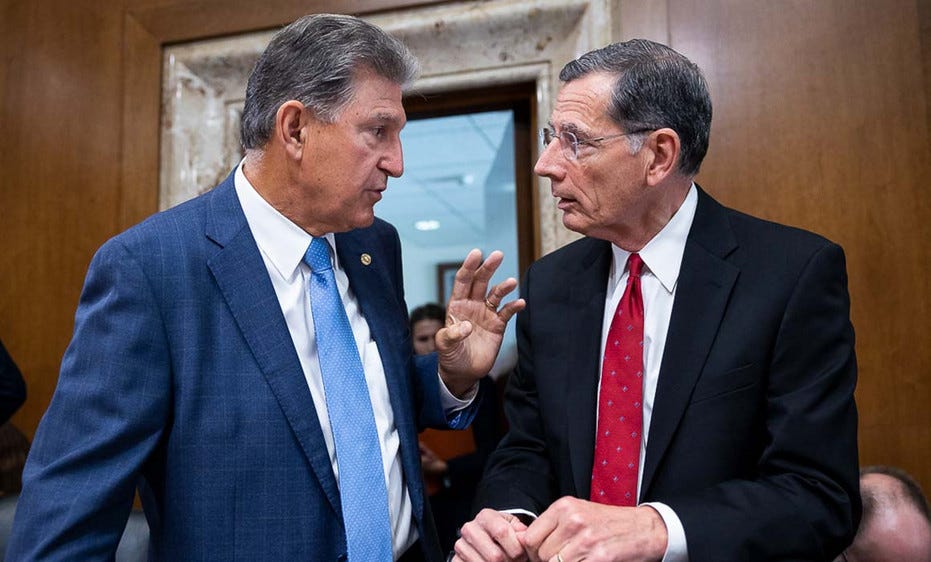
Permitting reform has been so important to Senator Joe Manchin (I-WVa) that it was part of the carrot used to entice him to vote for the IRA in the first place, back in 2022. Manchin’s own permitting reform bill was stymied by Senate Republicans back then. Now, Manchin has worked with Senator John Barrasso (R-WY) to put forward a new framework for permitting reform. The Energy Permitting Reform Act of 2024 (EPRA) passed out of Senate committee today with a 15-4 vote and now heads to the full Senate for consideration.
Is it good? Is it bad? What might its impact be?
What does the Energy Permitting Reform Act (EPRA) of 2024 do?
ERPA would make changes aimed at streamlining energy and infrastructure projects in multiple ways:
Judicial and legal changes
Renewable energy on federal lands
Oil and gas leasing on federal lands
Oil and gas drilling on nonfederal lands
Mining
Natural gas exports
Transmission
Judicial and legal changes (Section 101)
Reduce the statute of limitations to 150 days (down from 6 years) for filing lawsuits against a federal agency after it either approves or denies a permit for an energy or mineral project.
Establishes a 180-day (6-month) deadline for agencies to act on a remand (when a decision is sent back to an agency by a court for further consideration or a permit is vacated). There is currently no deadline for federal agencies to act on court remands.
Creates an expedited review requirement, where courts must prioritize reviewing agency permitting decisions for energy or mineral projects.
While these reforms may at first glance help reduce uncertainty for developers, they also dramatically reduce the window to meaningfully challenge projects that could harm the environment, effectively helping fossil fuel companies avoid legal and environmental accountability.
Renewable energy on federal lands (Sections 206 & 207)
In 2024, the Department of the Interior (DOI) announced that it had met its own goal of 25 gigawatts (GW) of renewable energy production permitted on federal lands. Section 207 of the EPRA requires that DOI increase its goal to 50 GW of renewable permitting on federal lands by at least 2030.
EPRA also:
Establishes application timelines for renewable projects requiring federal land right-of-way.
Requires an annual geothermal lease sale (currently required once every 2 years).
Requires annual offshore wind lease sales over the next 5 years (currently 3 scheduled) and requires leases to be at least 400,000 acres.
Oil & gas drilling on federal lands (Sections 201, 204, 301)
Clarifies a requirement that the Department of the Interior cannot lease federal land for wind or solar projects unless 50% of the proposed lease land was offered for oil and gas leasing in the previous year.
Sets timelines on federal review of coal lease applications. Applications must be reviewed within 90 days and a decision must be made within 90 days of an environmental review.
Requires one oil and gas lease sale in the Gulf of Mexico per year for the next five years (currently 3 scheduled). Sets the minimum acreage of a sale to 60 million.
Again, we see provisions that are quite favorable to the oil and gas industry. Although including a (very modest) provision about renewable goals for federal lands in the bill is nice, we see that these renewable leases are undermined by effectively requiring chunks of that land to first be offered to oil and gas companies.
Oil and gas drilling on non-federal lands (Section 203)
Removes requirements for federal drilling permits on land that the federal government does not own 50% of the subsurface mineral rights to or in cases where drilling occurs on non-federal land but then goes horizontally through federal land.
The argument here is that projects should only need state permits, not state and federal permits. In reality, this represents quite the coup de tat for the oil and gas industry. It is not hard to imagine that certain states will heavily favor oil and gas companies in the permitting process. It’s also easy to imagine a scenario where state regulators are more susceptible to pressure to ease requirements or change state permitting laws to be more environmentally lenient.
Mining (Section 210)
Allows mill sites to be used on mineral lands (currently only nonmineral federal lands).
Liquified natural gas (LNG) exports (Section 601)
Things get a little more complicated in this section of the EPRA. President Biden made news in January 2024 when he temporarily paused liquified natural gas (LNG) export approvals, facing calls to review their ultimate emissions impacts. In July 2024, a federal judge issued a stay, un-pausing LNG approvals.
What is an “LNG export approval”? If the US has a free trade agreement with another country, exporting LNG to that country has long been automatically determined to be “in the public interest”. This complies with The Natural Gas Act of 1938. If a country receiving our LNG exports does not have a free trade agreement with the US, then the Department of Energy must review and approve or deny the exporting agreement by declaring it to be in the public interest or not. These “public interest” determinations are made after a full environmental review under the National Environmental Policy Act.
The EPRA would:
Require a decision on public interest within 90 days of the submission of environmental review documents.
Establish a 90-day timeline for the review of previously approved LNG export authorizations, after which projects with no decision would be automatically approved.
Although this provision mostly deals with things that occur after an environmental review, the automatic approval after 90 days is controversial. In cases where environmental reviews are highly complex, a full and fair review for consideration by the Department of Energy may have difficulty meeting the deadline, resulting in automatic approval in situations where it may not be merited. Conceivably, the Department of Energy can increase its staff to meet this new requirement, but it’s hard not to view the requirement politically, putting pressure on the department to approve more LNG export projects.
Electricity Transmission (Sections 401, 402, 209, 501)
This section is arguably the most important for meeting IRA emissions reduction targets and bringing clean energy projects onto the grid. The EPRA:
Gives the Federal Energy Regulatory Commission (FERC) the power to permit transmission projects in the national interest. Currently, there must be a needs study conducted by the Department of Energy, who must then declare the land to be a “national interest transmission corridor” to permit the project. It is estimated that this could reduce approval process timelines by 2-5 years.
Notably, this means that projects would begin at the state level. If states balk at permitting for over 1 year (or deny permitting) for transmission projects, developers can then appeal to FERC.
Reforms cost-allocation processes for transmission lines so that customers pay for the line in relation to how much benefit they receive.
Establishes practices for interregional transmission planning.
Makes FERC the primary agency for conducting environmental reviews of transmission projects that require them under the National Environmental Policy Act. The justification is that FERC, whose 5 commissioners are appointed on staggered 5-year terms by the President with Senate consent, is more politically insulated than the Department of Energy, which currently conducts environmental reviews.
Directs agencies to create common exclusion definitions for transmission infrastructure in right-of-ways and for upgrades to pre-existing infrastructure. Effectively, these exclusion projects would then be streamlined and not require going through the federal permitting process with different agencies.
Requires reliability assessments of agency proposals’ effects on the grid by the North American Electric Reliability Corporation.
Final thoughts.
All in all, the permitting reform bill is quite generous for fossil fuel companies and dressed up with a few bones for clean energy advocates. While reducing so-called “red tape” is always popular and speeding up the deployment of new, cleaner technology is important, it shouldn’t come at the expense of hamstringing environmental and regulatory oversight for the public interest.
For instance, The West Virginia Coal Association President called the EPRA’s new reliability assessments provision “desperately needed”. It’s easy to see a world where these reliability assessment requirements could be misused to overturn federal regulation on coal-fired power plant pollution, which has long been linked to health and environmental damages. By simply declaring that requiring coal plants to meet higher emissions standards might cause them to shut down, the EPRA could negate the agency proposal by ruling that it makes the grid less reliable. This allows companies to avoid the costs of investing in cleaner technology and would keep coal burning, diminishing the federal government’s ability to do anything about it.
Completely removing the federal government’s role in permitting oil and gas on nonfederal land is a large political victory for Republicans, long advocating for “drill baby, drill!” However, given that drilling and burning fossil fuel creates negative externalities that the public collectively pays the price for, the federal government having some oversight is not a bad thing, inherently. Leaving it up to the states (just like the social issue of abortion) will create dramatically different sets of regulatory practices in different states and will also make state governments more prone to regulatory capture or worse, bribery or pay-to-play schemes.
All in all, it’s unclear why some aspects of this reform are necessary. The transmission and grid infrastructure streamlining will certainly help since navigating construction across counties and state boundaries is complicated enough without layers of multi-agency federal permitting. However, when it comes to the boons for fossil fuels, it’s hard to see any reason they are included other than to win Republican votes in the Senate. The US is not suffering from a lack of oil and gas permitting. In fact, the Biden administration is outpacing the Trump administration, including approval of the massive ConocoPhillips Willow project on federal land in Alaska. Given that the oil and gas industry is currently sitting on unused leases, its unclear why it’s of great importance for a permitting reform bill to focus so heavily on increasing the number of leases sold.
The Energy Permitting Reform Act of 2024 now heads to the full Senate and remains to be negotiated with the House of Representatives, which has proposed its own versions of permitting reform in the past.