


First and foremost — this is not a critique of the need for a domestic and well-functioning American semiconductor industry. But, it is certainly a criticism of using the same, misguided, corporate welfare playbook — namely, huge neoliberal policy carrots like government subsidies and tax incentives for financially risky private companies — to achieve the goal. This is the same “economic development” strategy we have seen over-promise and under-deliver for communities for nearly four decades. As the Biden administration races to shovel money out the door before January 20, 2025, we should pause and reflect on what, exactly, we are hoping to accomplish with the CHIPs Act. This will undoubtedly be an unpopular opinion, but one in which the data, and the technological facts, generally support.

A brief review…
In January 2022, U.S. chipmaker Intel announced that it would be building its ‘most advanced’ semiconductor manufacturing facility in Ohio. Semiconductors, or ‘chips’, have been a hot button topic in the U.S. as geopolitical tension continues to rise in Asia, where the vast majority of chips used in U.S. consumer electronics are currently produced by companies such as Taiwan Semiconductor Manufacturing Company (TSMC) and Samsung.
The announcement of Intel’s $20 billion facility in the Columbus-region was heralded by both Democratic President Joe Biden and Republican Governor Mike DeWine as a landmark event that would shepherd in a new so-called “advanced manufacturing” revolution and bring a booming tech economy to the Midwest. Shirts even sprang up at local stores emblazoned with the term "Silicon Heartland”. But, like a Cleveland Browns’ quarterback jersey, it seems that “Silicon Heartland” is just another name in a long list of places around the world who tried —and failed— to replicate the economic development strategies of Silicon Valley in California.

Intel’s planned factory in Ohio is heavily subsidized. The state signed an agreement with Intel in 2023 to provide $600 million in public funding for the project. But that doesn’t even include over $400 million that the state’s taxpayers are putting up for roads and infrastructure around the site nor does it count the $300 million that the state is spending to build a water reclamation facility. In July 2024, over 200 farmers and local business owners showed up to a hearing to push back on a proposed wastewater treatment plan for the region to accommodate Intel’s plant. Together, this total of $1.3 billion in direct and indirect taxpayer subsidy doesn’t even include the property tax exemptions at the county or local level. The City of New Albany approved a 30-year, 100% tax abatement for Intel in June 2022. JobsOhio, the state’s quasi-private economic development organization, has awarded intel over $20 million in grants. JobsOhio, notably, is funded by the state’s tax on alcohol sales and its not entirely clear how taxpayers in Cleveland, Youngstown, Toledo, or Cincinnati directly benefit from a heavily tax-exempt Intel plant outside of Columbus. But I digress…
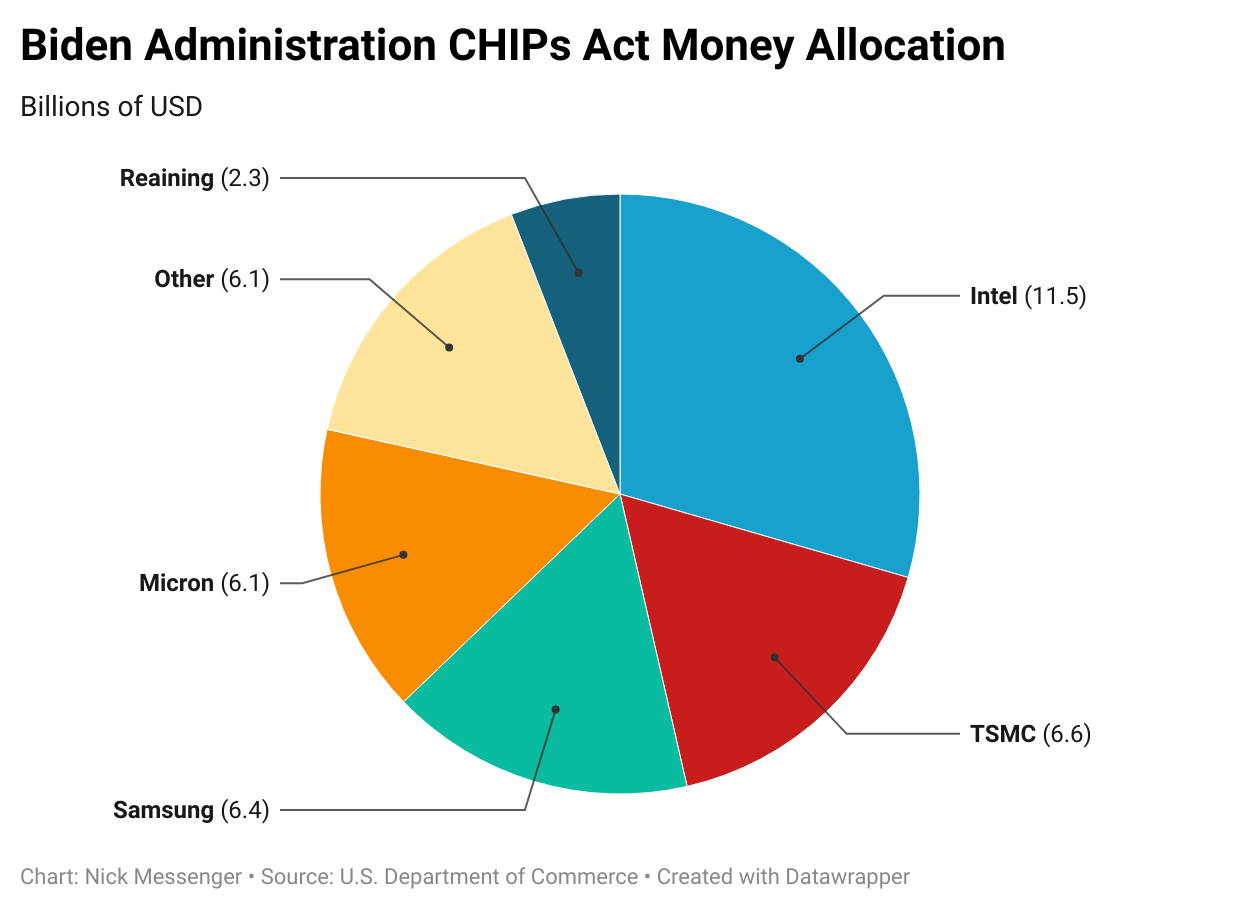
At the national level, Chips Act, passed by Congress and signed into law in August 2022, provides $39 billion in federal dollars for subsidies to chip manufacturers as well as 25% federal tax credits for manufacturing equipment. Intel’s portion of the grants, according to the Department of Commerce, total $11.5 billion for its projects across the country.
Importing the ingredients from China just to ‘cook’ the chips here— on the taxpayer’s dime— doesn’t solve any of the real national security issues.
As an aside, it’s equally important to note that, despite domestic semiconductor manufacturing being often referred to as a “national security issue”, more U.S. dollars are flowing to foreign companies Samsung and TSMC than to Intel. Furthermore, China still dominates the market for the rare earth metals and minerals that go into semiconductor production. Importing the ingredients from China just to ‘cook’ the chips here— on the taxpayer’s dime— doesn’t solve any of the real national security issues.
All told, Intel’s $20 billion “investment” in Ohio looks to be costing taxpayers somewhere around $7 billion, give or take, once you consider local, state, and federal subsidies, grants, favorable loans, exemptions, and credits. And it will continue to cost local taxpayers more as they figure out how to absorb and pay for new infrastructure demands and accommodate increased traffic; Intel isn’t going to build new highways, airports, transmission lines, and sewer systems out of its own pocket. Local residents and small businesses will compete with Intel for land, materials, and labor. Young farmers east of Columbus have already faced rising land costs as speculators bid up prices, squeezing their ability to expand (a phenomenon economists call ‘crowding out’). As realtors hopefully eyed a housing boom, the frenzy around Intel has done nothing to help the homeownership affordability crisis in the region, although current property owners looking to sell have certainly benefitted from the hype.
When I present to local audiences throughout Ohio, I often ask “how would you allocate $7 billion to help make Ohio a better place for families and young people to live and work?” Nobody ever says, “give it all to one company for one factory in one part of the state.” And, as I often tell folks, when Joe Biden and Mike DeWine both politically agree on the same thing, publicly, everyone else should be skeptical.
Intel’s technological (and financial) woes
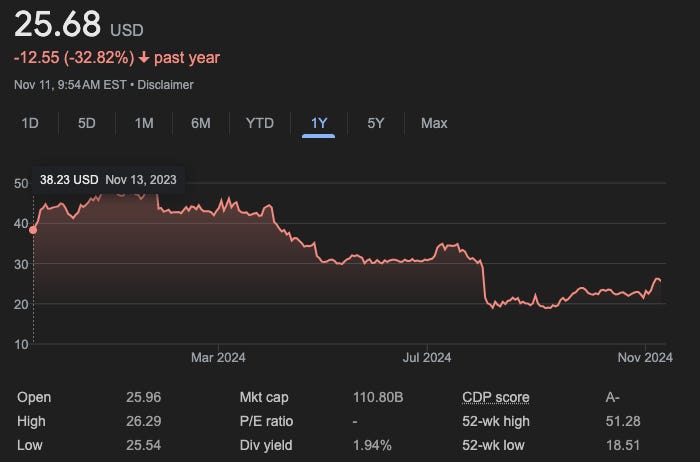
Now, you might be asking, “why is subsidizing an advanced technology industry a bad thing? Isn’t it in our national security interest to make our own semiconductors?” The answer is, yes. But the problem is that Intel is not a good company to bet on when it comes to the technology itself. Once an industry titan, the company’s struggles over the past decades have put it at a strong disadvantage as compared to its competitors. Taking a look at the company’s stock price, investors feel the same way. When the Ohio plant was launched, Intel’s stock price sat near $55 per share. As of this writing, it is less than half that. A recent Wall Street Journal article revealed that Qualcomm had approached Intel about a takeover..
The issue with all of this is that Intel, despite an aggressive turnout strategy, has been left behind by global tech developments. More than one Ohioan has lamented to me lately that they wish Nvidia — a chipmaker whose chips are considered industry leading technology for generative artificial intelligence (AI) — had been the one to invest in Ohio rather than Intel. Nvidia’s stock price was just under $30 at the time Intel announced its Columbus factory. As of this post, it sat at over $140 per share and has been a Wall Street darling for the past two years. It is also important to note that Nvidia is a chip design company — they outsource the actual manufacturing of their technology. TSMC is the primary manufacturer of Nvidia chips.
In the race to supply data centers run by Amazon, Google, and Meta with the most advanced chips as demand for streaming, cloud services, data storage, and computing power grows, Intel has been losing. Their CEO had hoped to not only invest and use government support to grow their own chip business but also break into the foundry business, enabling them to manufacture chips for designers like Nvidia themselves.
The problem is that the name of the game in semiconductor manufacturing is making things smaller and smaller. Fitting more transistors onto a chip increases its computational power and speed. There are entire engineering textbooks covering why and how, but suffice to say for now that Intel now lags its major competitors, who produce smaller, faster and more powerful chips. For example, TSMC’s most advancec chip manufacturing tech is at the 3 nanometer (nm) level. Intel is currently still working with 5nm tech and just rolling out 3nm chips soon. In this industry, several years of lag as tech customers seek faster, more efficient solutions, can feel like being decades behind. And, as a result, competitors like TSMC have grown their customer base in the foundry market on the back of more advanced technology. Intel hopes that the new plants it is building will allow it to catch up and siphon U.S. customers away from foreign chip makers. It is a big bet for the federal government to make with taxpayer money. And, if it pays off, Intel shareholders stand to benefit far more than the average U.S. citizen.
So far, the results have not been promising. In July, Gina Raimondo, the U.S. Secretary of Commerce urged big tech company executives from Apple, Google, Amazon, and AMD to buy more U.S. chips, including from Intel. They told her what is obvious to anyone who pays attention: tech companies are not going to buy inferior technology just because it is made domestically and the government invested in it. In August, Intel announced it was laying of 15,000 workers as part of a plan to save $10 billion while it waits for new facilities to come online. In October, the company announced delays to its Ohio site coming online.
In the final days of the 2024 Presidential Election, President-Elect Donald Trump panned the CHIPs Act. In an interview with popular podcaster Joe Rogan, Trump noted that “We put up billions of dollars for rich companies to come in and borrow the money and build chip companies here, and they’re not going to give us the good companies anyway.” Instead, Trump claims that tariffs alone will incentive foreign market leaders in the chip industry to locate their manufacturing in the U.S. This claim is also dubious, and perhaps deserves its own future post.
“We put up billions of dollars for rich companies to come in and borrow the money and build chip companies here, and they’re not going to give us the good companies anyway.”
- Donald Trump, October 2024 in an interview with podcaster Joe Rogan.
For now, the Biden White House rebutted candidate-Trump’s claims. “In the two years since the CHIPS Act was passed, the U.S. semiconductor industry has created 115,000 jobs and had more investments in factory construction than it did in the previous 24 years combined,” Natalie Quillian, the White House deputy chief of staff, was quoted saying in the New York Times. “We’re confident in the success of the CHIPS and Science Act.”
The only problem? The semiconductor industry hasn’t created 115,000 jobs since late 2022 (remember, Intel announced 15,000 layoffs…). This is incredibly easy to fact check. It’s not clear how the White House got their numbers— they didn’t say. Presumably they are trying to count all of the construction and auxiliary jobs for the various facilities around the country that the legislation subsidizes. It’s important to note that while those jobs are important for workers, they are A) largely temporary and B) do not offer the same pay and longterm compensation nor encourage tech workers to in-migrate to the region — which would be the key driver of any local economic growth that occurs.
Direct semiconductor manufacturing and equipment manufacturing employment is down since the CHIPs Act passed.
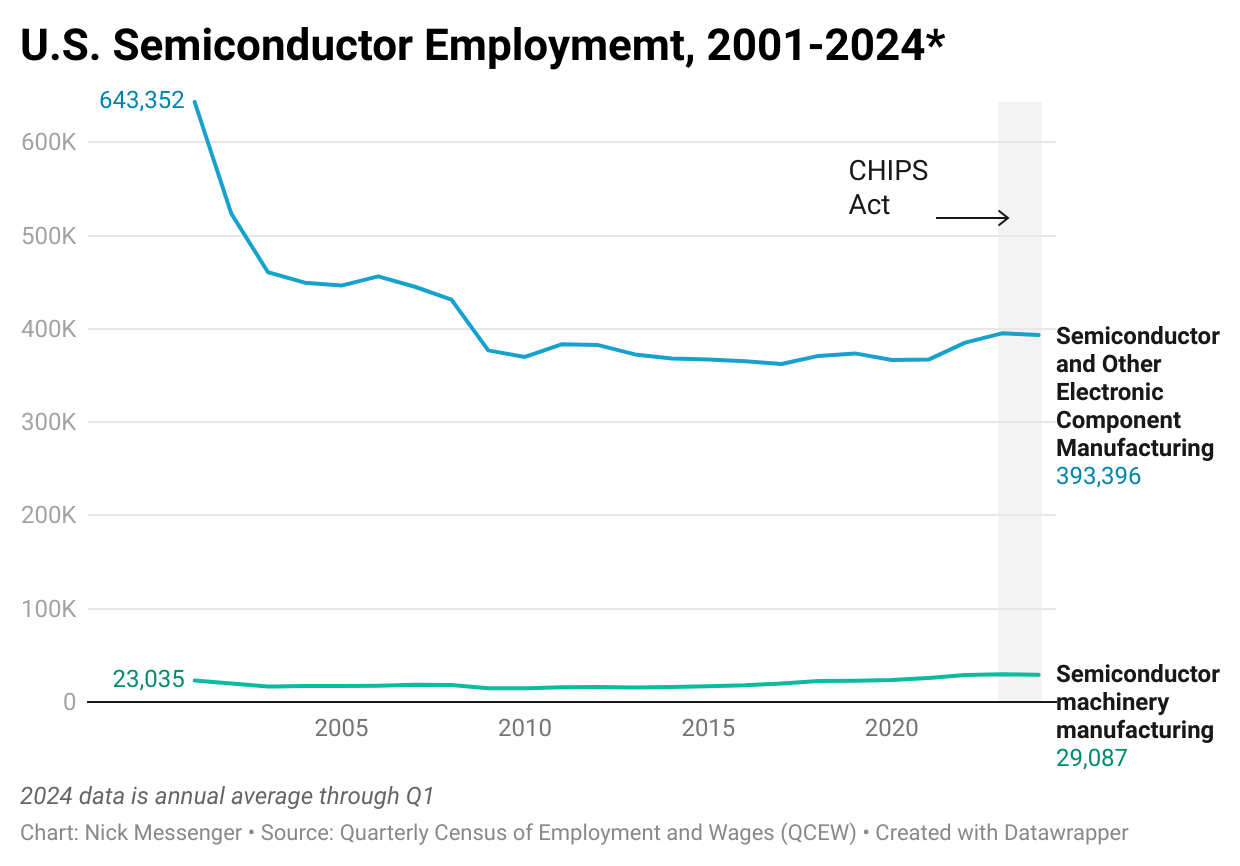
Data from the U.S. Bureau of Labor Statistics Quarterly Census of Employment and Wages (QCEW) shows that, since 2001 U.S. Semiconductor manufacturing has declined by over 38%, from 643,352 employees to 393,396. Manufacturing of semiconductor machinery is up by roughly 6,000 employees in the same time span. Since the start of 2023 after the CHIPs Act’s passage, U.S. employment in semiconductor manufacturing is actually down.
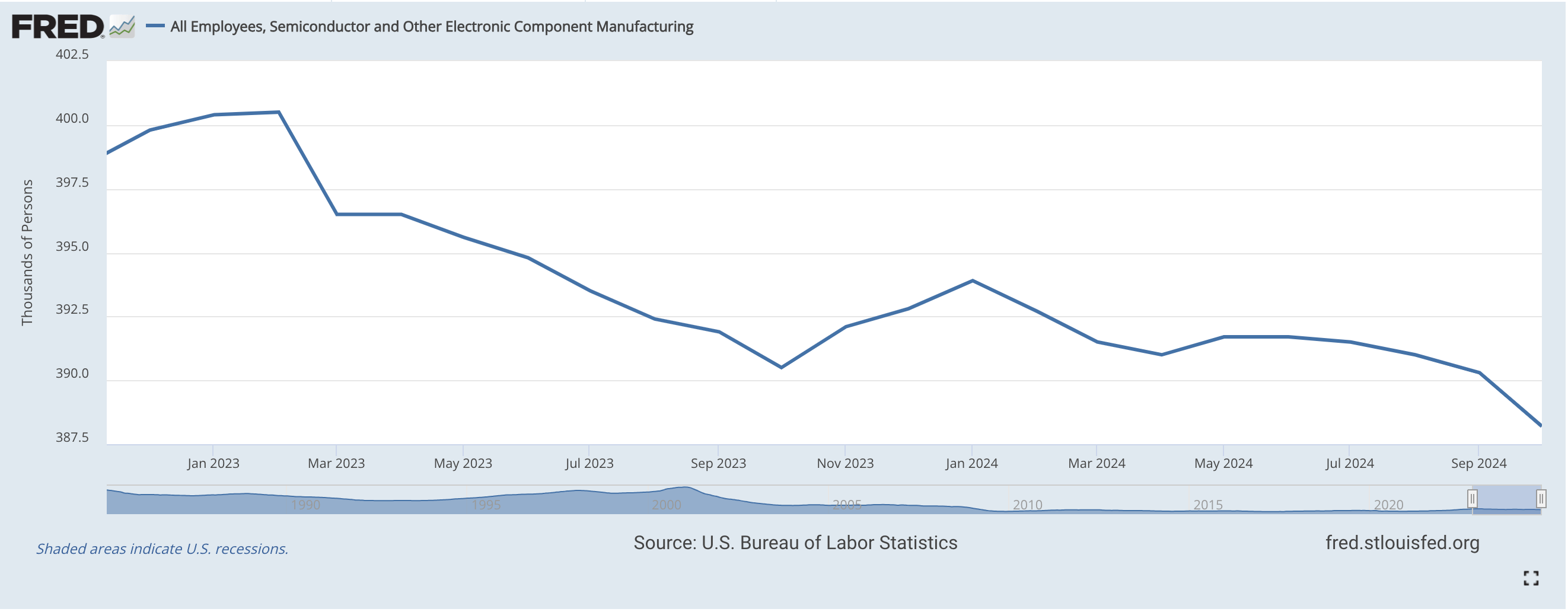
Even without downloading and analyzing the QCEW data, a simple Google search of the Federal Reserve bank data would have visualized this. The New York Times did not ask the White House for evidence of the “115,000 new semiconductor industry jobs”.
Since his election on November 5th, President-Elect Trump and U.S. House Speaker Mike Johnson have walked back their talk about a full repeal of the CHIPs Act. Uncertainty abounds, especially for local officials in Ohio and in other states where investment has been promised. But in reality, Trump’s initial promise may have actually been the right instinct — even if replacing the legislation with new tariffs is also a misguided solution.
Since the start of 2023, after the CHIPs Act’s passage, U.S. employment in semiconductor manufacturing is actually down.
Policymakers must become more educated and informed about the technology that actually underpins so much of the modern economy. The same playbook of throwing billions of taxpayer-dollar giveaways at the biggest name companies who promise the most domestic job growth will simply not pay off if those companies can’t deliver the actual cutting-edge technology that the market demands.
How do you think the US should deal with the problem of having most of the world’s chip made in Taiwan, a country at considerable risk of future supply disruptions? Taiwan itself achieved that position with considerable long-term government investment. Perhaps the Chips Act isn’t yet achieving all of the desired results. But of course all of the funds haven’t been spent yet and the problem is challenging. I’ve heard though that the TSMC Arizona facility is producing Chips well. Maybe Intel is just too far behind technology wise. But the ultimate goal here is primarily strategic - to make sure the US is not without the capacity to produce something it absolutely needs in the future. Not sure your Ohio-focused analysis can be used to deem that goal a failure yet.