


Last week, the Bureau of Labor Statistics released the monthly jobs data for January 2026. The U.S. economy added over 130,000 jobs according to preliminary data, far higher than analysts anticipated following the drastic downward revision by over 1 million jobs to the 2025 numbers.
I’ll provide an overview followed by a few quick personal thoughts on some industry trends I’ll be monitoring over the coming months.
First, I’ll let the BLS data speak for itself:
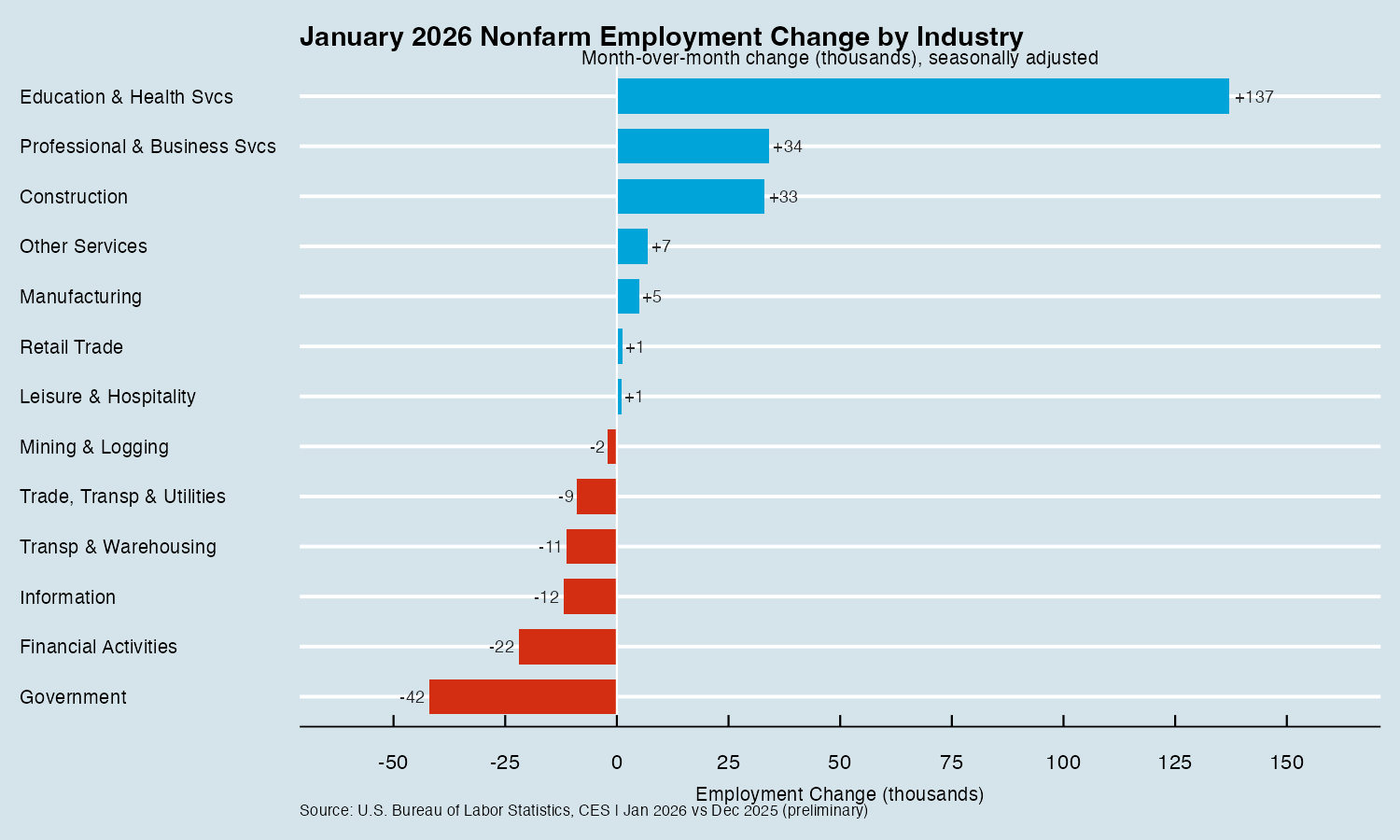
Now, a few key storylines I’m watching:
The news media have correctly highlighted that healthcare and social assistance were the biggest drivers of January’s net-positive job growth. This is no surprise, given that the healthcare industry overall continues to face drastic national labor shortages of doctors, nurses, and other providers with large numbers of job openings.
Manufacturing job growth was slightly positive following an uptick in factory orders coming out of December. This follows 26 months of decline in which the U.S. economy has shed over 200,000 manufacturing roles since 2023. We haven’t seen the kind of manufacturing “renaissance” from tariffs that was promised last April on ‘Liberation Day,’ although I suspect this month’s number will be used as a political talking point to suggest that tariffs are starting to work. I’ve been an outspoken critic of the chaotic and haphazard implementation of President Trump’s trade policies, so I’ll be monitoring this sector closely in the next few months to see whether January is the beginning of a new trend or just a blip from supplier reorders after the holiday season.
Although some analysts are wish-casting a small impact from artificial intelligence (AI), the impact is only likely to increase as the year goes on.
Yes, the top-line jobs number was positive. But healthcare and services are much harder to automate than, say, the Information and Financial Service sectors that lost jobs in January. We’ve seen big tech companies queue up more layoffs for 2026. In late January, Amazon announced 16,000 layoffs as part of efforts aimed at reducing corporate bureaucracy. It shed about 14,000 roles last October in a previous round of layoffs. Other financial and technology companies like Citibank and Angi have announced coming layoffs, citing both AI directly and a need to carefully assess needed skills moving forward. Meta has plans to lay off approximately 1,500 workers in its virtual reality division as it shifts resources toward investments into datacenter and AI buildouts.
Microsoft’s AI boss has recently predicted the mass automation of white-collar jobs, and the reveal of Claude Opus 4.6 by AI company Anthropic rattled the stock market earlier this month; the mass loss of software development jobs is perceived as a real risk to previously stable career pathways. In a recent World Economic Forum survey, 41% of responding companies said they planned to reduce their workforce due to artificial intelligence by 2030, as AI capabilities rapidly advance from chatbots and content creation to completing and automating multi-step coding, writing, and organization tasks.
The government job loss this month (~42k) was driven primarily by ~34,000 lost federal jobs as employees who accepted deferred resignation options from the Trump administration fell off the payroll. Although it’s politically popular to criticize bloated federal spending, the federal workforce supports a huge number of jobs both directly and indirectly all over the country. Every federal employee in a county largely lives locally, pays bills locally, and spends their money locally at other businesses. Economists call this the multiplier effect, and as we see large-scale federal workforce reductions, there will be negative ripple effects in unexpected places.
In short, although the headline jobs number was positive, the job growth last month was driven by healthcare and social assistance, and shows some concerning underlying trends in sectors that have traditionally employed recent college graduates. I’d still characterize this job market as largely frozen; it’s possibly the worst time to be a new, non-healthcare college grad seeking an entry-level position since 2009. That serious labor market friction has important consequences for the economy as a whole and could affect the political environment in the short-term as we head into this year’s midterm elections. I’ll be monitoring these “easier-to-AI” sectors closely throughout this year.
For more discussion on the AI-reckoning that could be coming for white-collar jobs, and how that could dramatically impact the economic and political environment, Ryan Zickgraf has an excellent new piece here that a colleague forwarded me and I’ve subsequently shared widely.