


In March, the U.S. government announced the most ambitious new AI data center project to-date in partnership with SB Energy, a subsidiary of the Japanese tech investment company SoftBank. The plan is to build a massive new data center located on the site of an old uranium enrichment plant in Pike County, Ohio. The US government plans to ultimately lease the plant to a private AI company, and the New York Times reports that Commerce Secretary Howard Lutnick will have an ultimate say in who is ultimately awarded use of the plant’s computing power.1

The planned data center is absolutely massive. So massive, in fact, that a separate $33 billion, 10-gigawatt gas-fired power plant is being built to run it. But just how big is 10 gigawatts? Unless you’re an electrician, engineer, or physicist, this number probably needs additional context beyond “giga” sounding pretty big. I don’t mean to give anyone a flashback to math class (although I have gained an appreciation for math class as I get older), but let’s walk through some (simple-ish) math together. This should help us appreciate just how insanely large this project could be, and how insanely large the emissions and pollution associated with it could be. This is envelope math and may change over time as more permitting and technical details emerge.
How much total electricity does America use in a year?
First, we should put this in context. How much electricity does America actually consume today? According to the Energy Information Administration (EIA), in 2025 the U.S. used 4 trillion kilowatthours (kWh).2 Sounds cool. What does it mean?
Watts and watt-hours are different things. Watts measure the rate of power being delivered instantaneously, right-this-second. Sort of like “miles per hour” in a car. It can go up or down over the course of a trip. Watt-hours are more like your total miles traveled in a trip (This analogy is a little clunky, but it’s the one I used to use when I taught high school physics. Hopefully you get the idea.)
Basically, a kilowatt-hour is your total energy use over time.
So let’s compare total U.S. electricity use to this new plant. I’ll note that the total data center is planned to operate on 10 gigawatts but the proposed gas plant may provide approximately 9.2 gigawatts, with other sources providing the rest. So we will use 9.2 gigawatts moving forward in these estimates. The first step is that we need to convert this measurement from gigawatts into kilowatts and then convert those kilowatts into kilowatt-hours. Hooray for the metric system!
Here we go:
So the Pike County plant as announced would have a plate capacity of around 9.2 million kilowatts. To get this into kilowatt hours in a year, that means:
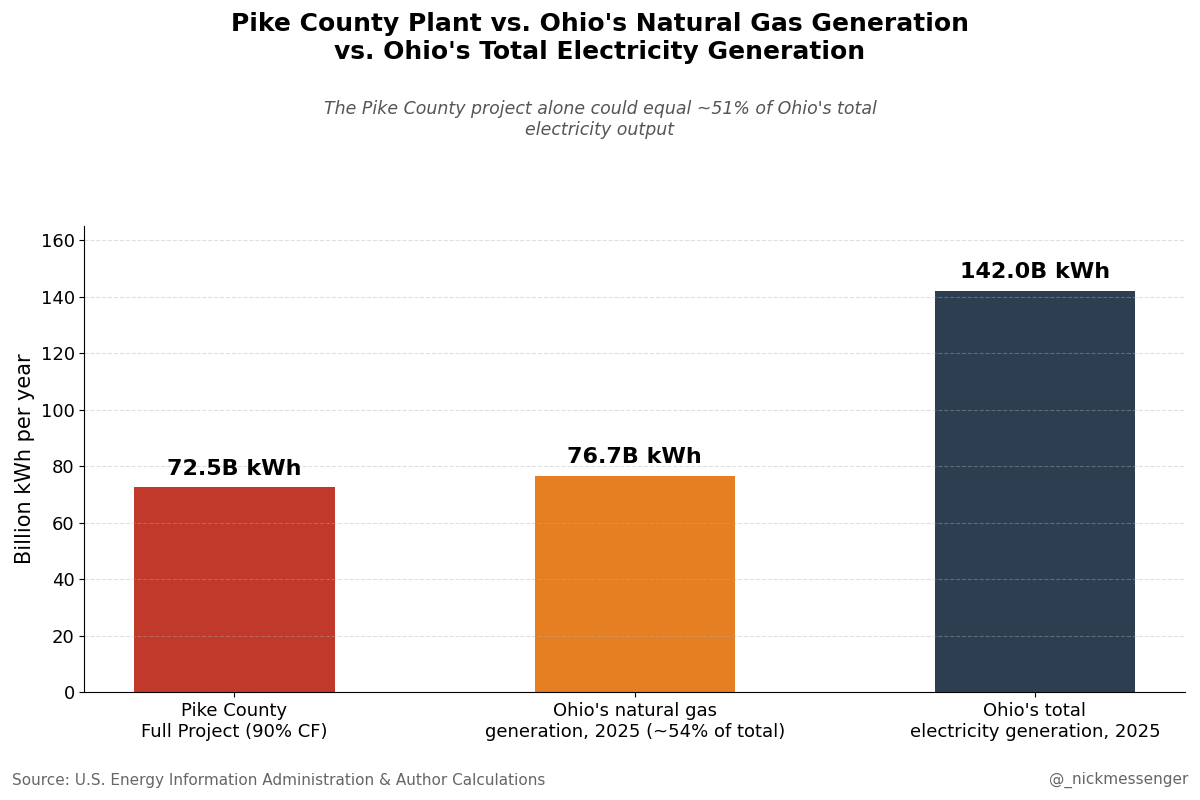
The end result: the Ohio gas plant could produce up to roughly 80.6 billion kWh per year at 100% usage (more on that later). Let’s see what percentage of total U.S. consumption that is:
This means that a single planned natural gas power plant in Pike County, OH, which is expected to be one of the largest gas-fired power plant in the world, could produce the equivalent of 2% of all 2025 electricity used in the United States.
The entire state of Ohio produced around 142 billion kWh of electricity according to the most recent available estimate which is for 2024, so this single plant would also be equivalent to roughly 50% of all of Ohio’s normal load electricity generation. According to preliminary EIA data, about 54% of Ohio’s existing electricity generation came from natural gas in 2025. That means this new gas plant could roughly double all of the electricity generated from gas last year in Ohio.
What percentage would the Pike County plant be of all current U.S. data center electricity usage?
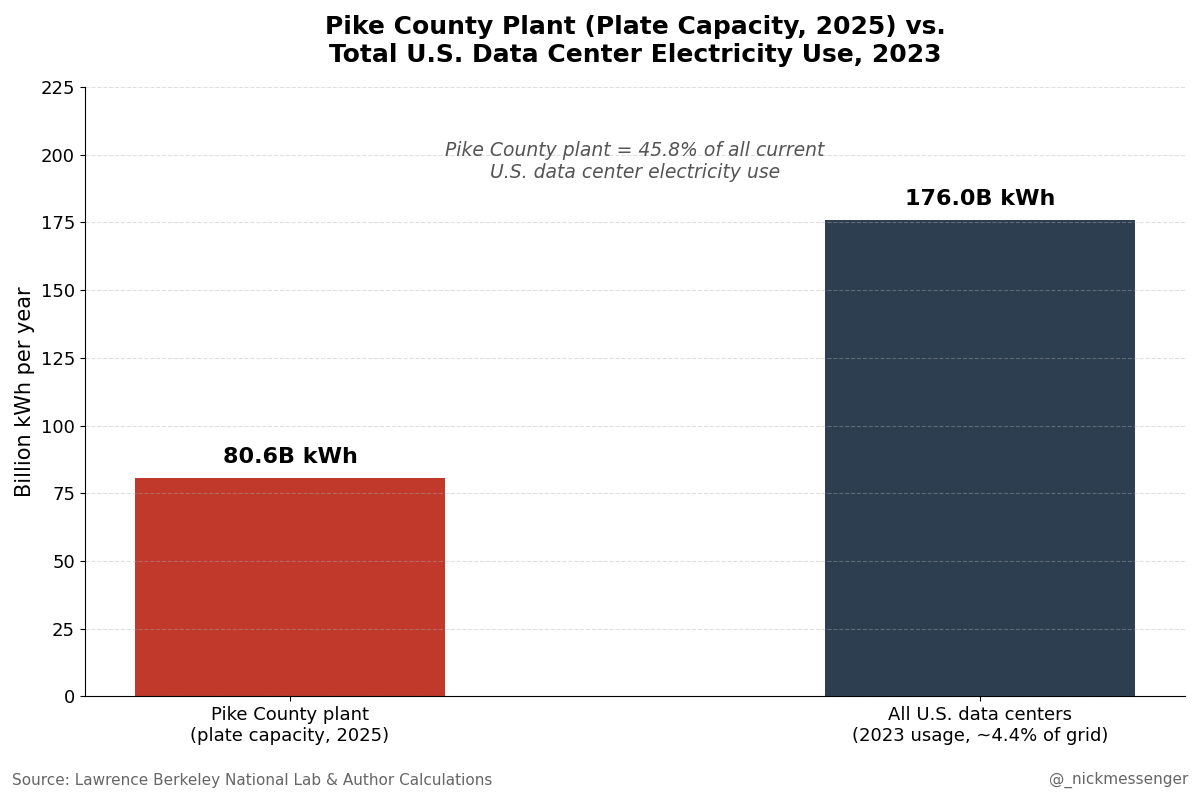
In 2023, which is the most reliable recent data available from Lawrence Berkeley National Lab, data centers used approximately 4.4% of all electricity in the U.S.3 That’s about 176 billion kWh.
Some more (simpler math) can tell us how big the Trump administration’s new Ohio data center project is:
This number hopefully underscores how huge of a deal this project is. This single data center in Southern Ohio has the theoretical capacity to increase the total annual electricity consumption of data centers in America by 45.8%.
How much natural gas burning does that mean?
We have to acknowledge that a power plant’s maximum capacity and its actual output aren’t the same thing, for two key reasons:
First, energy transformations aren’t 100% efficient. Some of the energy from burning natural gas is lost in the process as unproductive heat, which doesn’t get converted into electricity. A really, really good combined-cycle natural gas power plant can get about 65% efficiency.4
Second, we have to acknowledge that most plants don’t operate at their plate capacity 24/7 because our demand for grid electricity ebbs and flows throughout the day, and across different seasons with different weather. The grid also relies on many, many different generation sources (coal, gas, nuclear, and renewables) that work together and could be called into service or idled at any given time, based on our demand.
The degree to which a plant does operate is called its “capacity factor.” For normal power plants, this is somewhere between 50-60% of their plate capacity. For AI data centers, though, which do actually run 24/7, the targeted capacity factor could be as high as 90% if the data center isn’t connected to the grid and exclusively relies on its own power plant.5 There’s not a surefire way to know exact capacity factors for these private plants without really getting into the weeds. A lot depends on how the data center operator wants to configure the servers in the data center. For example, some data centers may only run a portion of their servers 24/7 for AI, with some of their chips waiting as backup and not drawing as much power.
For the rest of these ballpark estimates, I’ll be extra conservative and assume a 60% capacity factor rather than 90%, which means the Pike County power plant would only need to generate 5.2 gigawatts of electricity continuously. I’ll use a fuel efficiency of 65%, assuming a top-of-the-line modern generating equipment.
I’ll spare you some of the math, but the gist is that we need to convert the true electricity generation (the 5.52 gigawatts) into heat energy units called Btus, since that’s what fuel is measured in (all energy can be converted amongst different units.) Spoiler: it’s about 165 TBtus (1 kWh = 3,412 Btus).
I’ve accounted for the plant not maxing out its capacity 24/7, but still need to account for the efficiency of the fuel burning. We can adjust that by the assumed 65% generator efficiency, which is pretty much the most efficient generator we could hope for.
Why’d we get a bigger number? This makes sense if we stop and think about what the math is saying. It would need to produce ~165 TBtus worth of electricity (that’s the same amount as 5.52 gigawatts). But not all of the chemical energy stored in natural gas molecules gets converted cleanly and efficiently into electricity. So this is saying we would need to burn 253.8 TBtus worth of gas to get out 165 TBtus (5.52 gigawatts) of electricity to run the data center. In other words, 88.8 TBtus per year are lost in the transformation process between burning gas and making electricity.
Now, let’s figure out how much natural gas (measured in cubic feet) we need to fuel this thing. Natural gas produces about 1,037 Btus per cubic foot. More math:
And, let’s compare that to U.S. total dry natural gas production in 2025, which was approximately 39 trillion cubic feet.6
Okay, so what’s the big deal? Less than 1% of total U.S. natural gas production? Think about it this way: U.S. natural gas production grew by roughly 4% in 2025, which meant more fracking, drilling, burning, and overall emissions and pollution.
If all of the natural gas drilled and extracted for this one data center is hypothetically net-new production, it would represent about 13-15% of the total annual growth in U.S. natural gas production last year, depending on how you measure. This is a very large project for the natural gas industry.
What could that mean for emissions?
The last bit of envelope math here. The EIA estimates roughly 120.85 pounds of CO2 are emitted for every 1,000 cubic feet of natural gas consumed. That’s about 29.6 billion pounds (13.4 million metric tons) of CO2 that could be emitted from the Pike County plant to power the AI data center.
I hate the cliche of putting things in “car terms” when we talk about emissions, but I’m going to do it here to again underscore the massive scale of this thing.
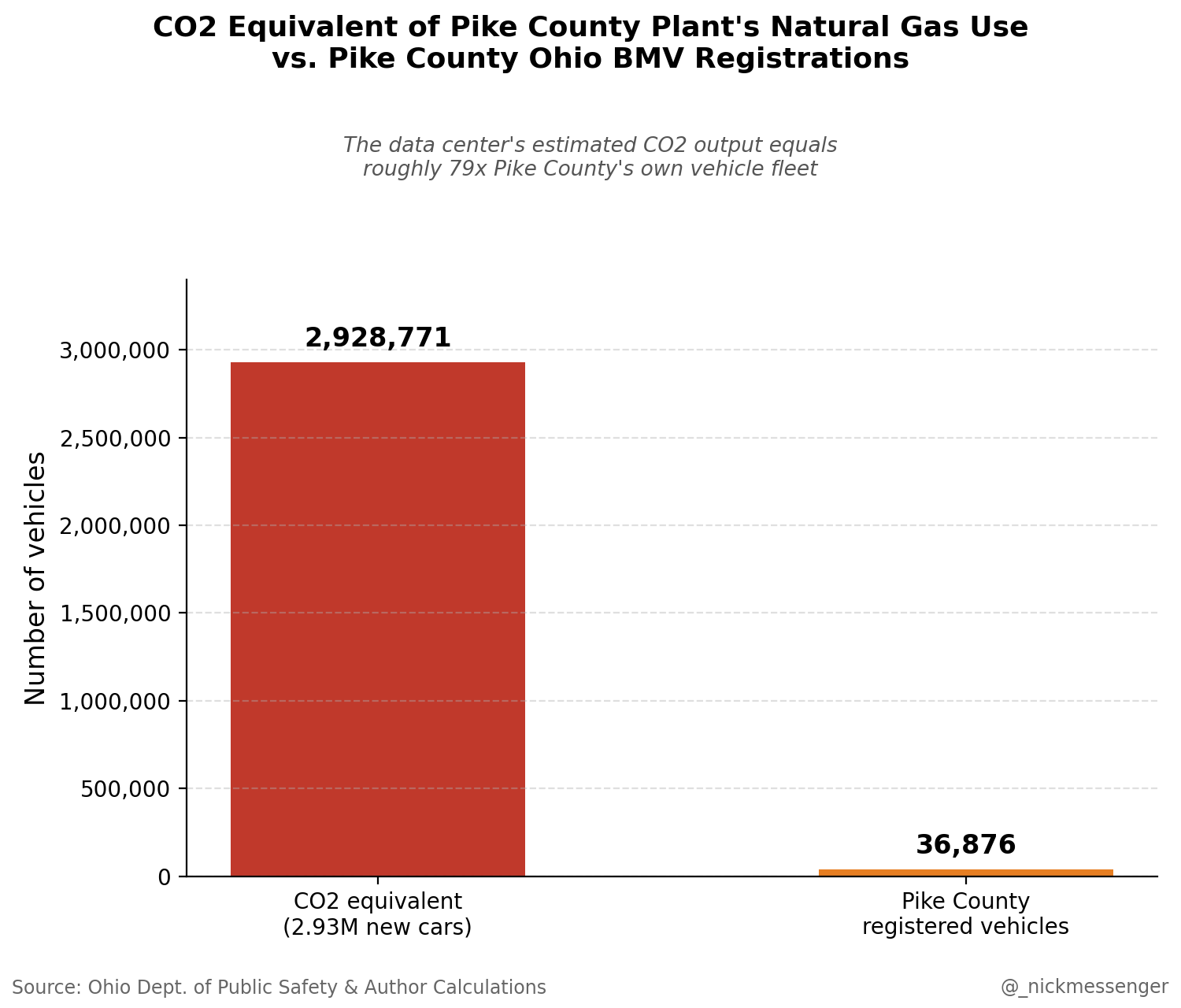
An average car in the U.S. produces about 10,100 pounds of CO2 in a year.7 That means that this single data center power plant could emit the CO2 equivalent of 2.93 million new cars on the road every year. There are currently only 36,876 vehicles registered with the Ohio BMV in Pike County and 13.3 million registered vehicles in Ohio.8 That would mean an average emissions equivalent of a 7,942% increase in the number of vehicles in Pike County and represents the emissions equivalent of 22% of all of Ohio’s vehicles.
What comes next?
The first phase of the project, which is for 2.2 gigawatts, is in the Pre-Application phase of its case with the Ohio Power Siting Board (OPSB) as of publication. There are complex financial, technical, tax subsidy, and energy details to this project that will be filed as part of that process. The federal government is also deeply involved.
The numbers in this post aren’t meant to be final, exact estimates or forecasts and will definitely shift a bit as the public gets more information. This post’s math exercise was really to help my own understanding (and hopefully yours) of just how big this project could really be. There’s no other way to spin it — this project as currently reported would be huge, would consume lots of natural gas, would produce a lot of power for an AI data center (potentially for OpenAI), and could produce tons (literally) of new emissions that contribute to climate change.
I’ll post more as time goes on and the project’s permitting process unfolds this summer and fall, including a potential deep dive into its economics and any federal, state, or local taxpayer subsidies it could end up getting.
The New York Times. (2026, July 27). OpenAI data center Nvidia [Article]. https://www.nytimes.com/2026/07/27/technology/openai-data-center-nvidia.html
U.S. Energy Information Administration. (2026, April). Use of electricity. https://www.eia.gov/energyexplained/electricity/use-of-electricity.php
Shehabi, A., Newkirk, A., Smith, S. J., Hubbard, A., Lei, N., Siddik, M. A. B., Holecek, B., Koomey, J., Masanet, E., & Sartor, D. (2024). 2024 United States data center energy usage report. Lawrence Berkeley National Laboratory. https://doi.org/10.71468/P1WC7Q
Siemens Energy. (n.d.). Combined cycle power plants (CCPP). Siemens Energy. Retrieved July 30, 2026, from https://www.siemens-energy.com/global/en/home/products-services/product/combined-cycle-power-plants.html
Schoeman, H. (2026, April 29). AI data center power requirements: The complete capacity planning guide for hyperscalers. USP&E Global. https://uspeglobal.com/articles/ai-data-center-power-requirements/
U.S. Energy Information Administration. (2025, July 29). U.S. marketed natural gas production has increased by more than 80% since 2005. https://www.eia.gov/todayinenergy/detail.php?id=67684
U.S. Environmental Protection Agency. (2026). Greenhouse gas emissions from a typical passenger vehicle. https://www.epa.gov/greenvehicles/greenhouse-gas-emissions-typical-passenger-vehicle
Ohio Department of Public Safety. (2026). Tax distribution: Detailed statement of motor vehicle registrations for year 2025 [County summary by vehicle type]. Ohio Bureau of Motor Vehicles. https://bmv.ohio.gov/links/2025-County-Summary-by-Vehicle-Type.pdf