


“Permitting” is the policy wonk phrase that refers to the web of government regulations and approval processes that new construction projects must go through in the United States before they can be built. There are many processes, across many state and federal agencies, that have been created by many pieces of legislation over the decades. Some of these are landmark acts that have established important environmental protections that you’ve probably heard of, like the Clean Air Act, the Clean Water Act, or the National Environmental Policy Act (NEPA).
The entire process of getting a new major construction project approved is a massive ball of yarn that can take a long time to unwind, especially if it involves building on government land, using taxpayer money, or infrastructure crossing state lines (like oil and gas pipelines or electrical transmission lines). Often, even if a project get permitted, groups that oppose the project can pursue lawsuits that then become ensnared in the U.S. courts and drag project approvals out for years. Sometimes these lawsuits are meritorious and challenge harmful projects and sometimes the legal process can be used as a political prop or a tactic to stall the project until it becomes financially unviable. A lot of people have been trying for a long time to pass some version of “permit reform,” which is another catch-all term that means streamlining regulation and allowing American companies to build things faster.
That might sound popular, at first glance. But for a long time, “permit reform” has been a sort of benign code phrase that really means “let private companies build oil and gas pipelines, industrial factories, petrochemical facilities, and (more recently) data centers without so much pesky environmental protection regulation.” The fossil fuel industry in particular has often painted environmental groups that oppose permit reform as “radicals” or “tree huggers” who they claim simply want to maintain the ability to sue them. Recently, however, permit reform has become an extremely hot, albeit very nerdy, topic that has gained support from a subsection of neoliberal environmental policymakers.
Why is permitting reform now a clean energy issue?
If you believe that climate change is a critical issue facing society (I do) and that we should strive toward net-zero (we should), then one of the biggest challenges that we face is reducing greenhouse gas emissions and air pollution by decarbonizing our electricity grid. And presumably, we need to decarbonize it without simultaneously causing major disruptions (people like their lights turning on and heat and air conditioning running) and without spiking everyone’s electricity bill.
There are endless deep-dive posts about the grid, but suffice it to say that, big picture, the grid has undergone two key major shifts this century: first, coal, which was once the main source of electricity in the U.S., has dramatically declined and our major baseload power has been shifted to natural gas. Second, solar and wind have dramatically grown and now account for roughly 20% of U.S. electricity generation.1
But solar and wind face some unique obstacles that slow down their progress in ways that continue to advantage natural gas. First, building new solar and wind means that you need to build in more rural areas, farther away from where most Americans live and use electricity. To get electricity from where it’s made to where it’s used generally involves two types of power lines. Transmission lines are high-voltage bulk carriers that go from the generation site to a substation. Distribution lines then get the power from the substation to your house. So, if we want more renewable electricity on the grid, we are going to need more transmission lines that connect those wind and solar sites to the substation. The advantage for natural gas here makes sense; you only need to connect one gas power plant instead of more geographically dispersed wind and solar locations.
The other thing we have to consider is that America’s grid is actually a patchwork system of smaller, regional mini-grids. This becomes important when we consider that wind and solar don’t produce at the same efficiency everywhere (imagine a solar farm in Seattle or Ohio vs. Arizona or Texas). One major goal of clean electricity advocates is making it easier to move electricity from low-cost, highly efficient areas of the country to higher-cost areas. Achieving this would also take a lot of new transmission line construction and, in particular, transmission lines across state lines and between different regional grids. Currently, there are zero miles of high-voltage interregional transmission lines being built under the federal flagship process that’s supposed to do this.2
Another problem that I won’t dive deep into but is important to note is that for-profit utility companies have a perverse profit motive to invest in inefficient local projects that they control rather than more efficient interregional ones that might favor more renewable energy. Ultimately, rate payers are on the hook.
The general logic to understand about both the transmission and the profit motive is this: some clean energy advocates believe that a permitting reform bill that removes barriers to transmission and allows more interregional electricity flow will inherently move the grid toward more clean energy in the long run.
So what’s all the fuss about the new permitting reform bill?
If you’re still with me, let’s now get into the new permitting reform proposal. Back in September, a bipartisan group of U.S. Senators, including Senators Shelley Moore Capito (R-WV), Sheldon Whitehouse (D-RI), Mike Lee (R-UT), and Martin Heinrich (D-NM) introduced the Bipartisan American Affordability and Jobs Act (BAAJA) of 2026. The introduction of BAAJA made political waves because Senators Whitehouse and Heinrich are widely perceived as some of the staunchest environmental advocates in the Senate, while Senators Lee and Capito are perceived as big supporters of the fossil fuel industry. At first glance, the bill seems like a big compromise and the type of bipartisan problem-solving that Americans haven’t really seen in the Trump or Biden eras.
Indeed, there were immediate victory cries across social media from Biden-era climate policymakers to the American Petroleum Institute. The White House heralded the deal as part of its strategy of “unleashing American oil and gas dominance,” while clean energy groups claimed that the bill would reduce greenhouse gas emissions primarily through more interregional transmission.
The water has gotten muddier, though, since the bill was introduced. The Trump administration has slow-walked its good-faith commitment to unblock wind developments, leading Senator Whitehouse to publicly call the future of the bill into question should they not follow through.3 John Podesta, a former White House Chief of Staff to President Bill Clinton and later a senior climate and energy advisor to President Joe Biden, praised the interregional transmission aspects of BAAJA but cautioned that the bill needed revision and currently hands a “loaded howitzer [for Trump] to go after public lands, to permit stuff that even if it's illegal can't be reversed by the courts.”
Podesta’s critique gets at the heart of opposition by some environmental advocates (including myself) to the current version of BAAJA. While I agree that interregional transmission planning and transmission capacity growth are key to decarbonizing the grid, I also believe that the bill’s supporters may be so blinded by this singular focus that the rest of BAAJA, which reduces the ability for litigation and court intervention for even illegal projects, reduces environmental impact reviews for some projects, and would make expanding natural gas pipelines much faster and easier, that they are on the verge of making a bad horse trade for the climate at large.
Data centers are the core problem.
The rapid construction of AI data centers all over the country has (we think) dramatically shifted America’s electricity landscape. I say “we think” because the verdict is still out on whether every AI data center will really come online and be profitable, and the best anyone can do is make projections into the future. A lot of planning is occurring as if the AI bubble won’t totally burst, which I note is probably safer to plan for than the alternative where it doesn’t burst and we don’t have the electricity or reliable infrastructure to affordably accommodate it.
To understand this, we have to put the data center buildout in context. In the first half of this year, 189 gigawatts of new natural gas capacity was proposed as part of behind-the-meter (private, off-grid) data center projects or utility buildouts for data centers across the country.4 Due to supply chain constraints, some estimates find that about a quarter of these projects are using less efficient single-cycle gas turbines (which produce more emissions) and could increase power-sector emissions by 20% over 2025 levels.5 The AI data center buildout ultimately means that the U.S. is planning to build natural gas plants at twice the speed of China.
BAAJA’s big bet is that if we make the grid more accessible and cleaner by making interregional transmission lines easier to build, data centers will abandon their natural gas plants and connect to the grid. And, to prevent this from creating new costs to normal households (who have to pay higher rates when utility companies build new infrastructure), BAAJA contains a provision requiring data centers to “pay their full freight” of costs associated with connecting to the grid. This is being sold as a binding legislative version of President Trump’s voluntary “rate payer protection pledge.”
BAAJA might not make the grid an affordable alternative for data centers, might not do it fast enough, and simultaneously speeds up permitting and reduces legal challenges to natural gas pipelines.
BAAJA supporters are generally correct that today a grid connection is cheaper in levelized cost terms than a behind-the-meter private power plant. It takes a lot of money to build your own gas power plant and run it 24/7, and if the AI data center bubble does burst, you’d have what is called “a stranded asset” that you invested a lot in but cannot make you money because it is not connected to the grid to sell the power back to other users. In short, BAAJA advocates make an assumption that technology companies would prefer to diffuse their own risk and just plug into the grid to run their data centers.
This assumption makes sense but also only holds if 1) the grid is reliable and can deliver hundreds of megawatts of power constantly to the data centers and 2) the cost of the grid is actually cheaper than just building a private power plant that is fully controlled by the company.
My analysis finds that BAAJA would generally not achieve this goal, primarily because of two forces. First, the grid would still carry a longer “time to power” period due to needing to construct new transmission and generation capacity and then connect the data center site. There is strong evidence that data center developers are valuing time to power so highly that it justifies the capital expenditure of building the entire behind-the-meter plant.6 My modeling drops the grid time to power from around 60 months (5 years) under BAAJA to 48 months (4 years), but this still lags the 18-30 month estimates (I use 30 conservatively) for behind-the-meter plants. As such, even a faster and cleaner grid will inherently carry a time-to-power penalty.
Second, the same ratepayer protections that BAAJA proponents are highlighting actually may increase the cost of using the grid for data centers and thus make it a less attractive alternative to behind-the-meter gas. The big factor here is that BAAJA would require data centers above a certain threshold to pay the full incremental cost of their own generation and transmission capacity upgrades, and that cost can’t be shared with other customers, which is otherwise a major attractive feature of the grid.
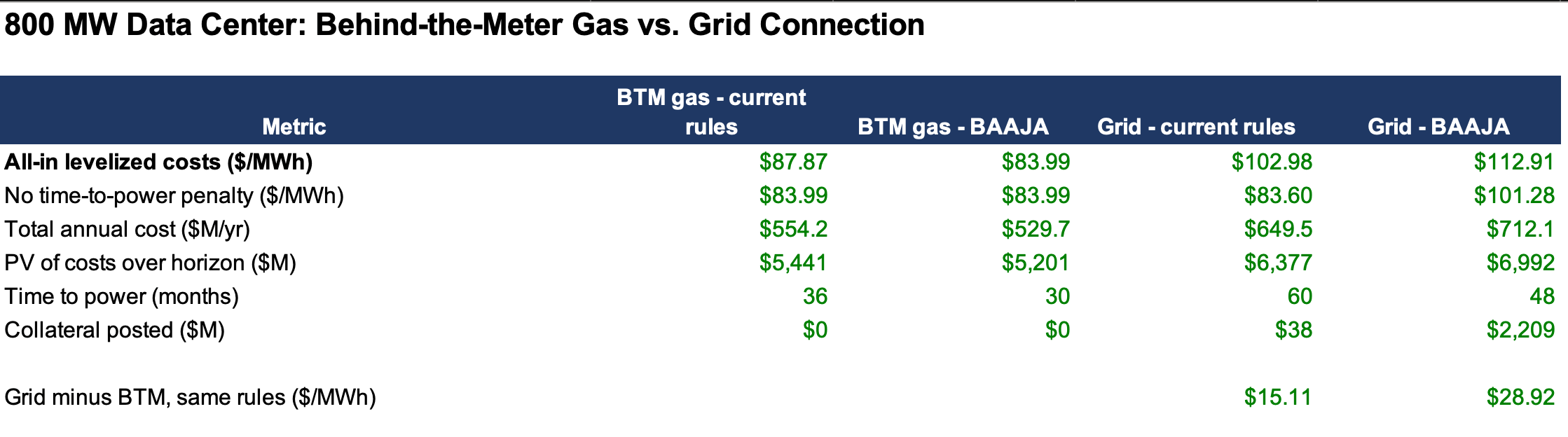
Combining these two factors (longer time to power alongside higher-than-present grid costs for data centers) with the compromise components of BAAJA that speed up gas pipeline expansion and construction and reduce the window and effectiveness for litigating projects might actually mean that data centers simply continue on their current trajectory of using behind-the-meter. My analysis finds that the gap in cost per megawatt-hour between behind-the-meter and the grid may actually grow under BAAJA from around $15 to around $28 under current market conditions.
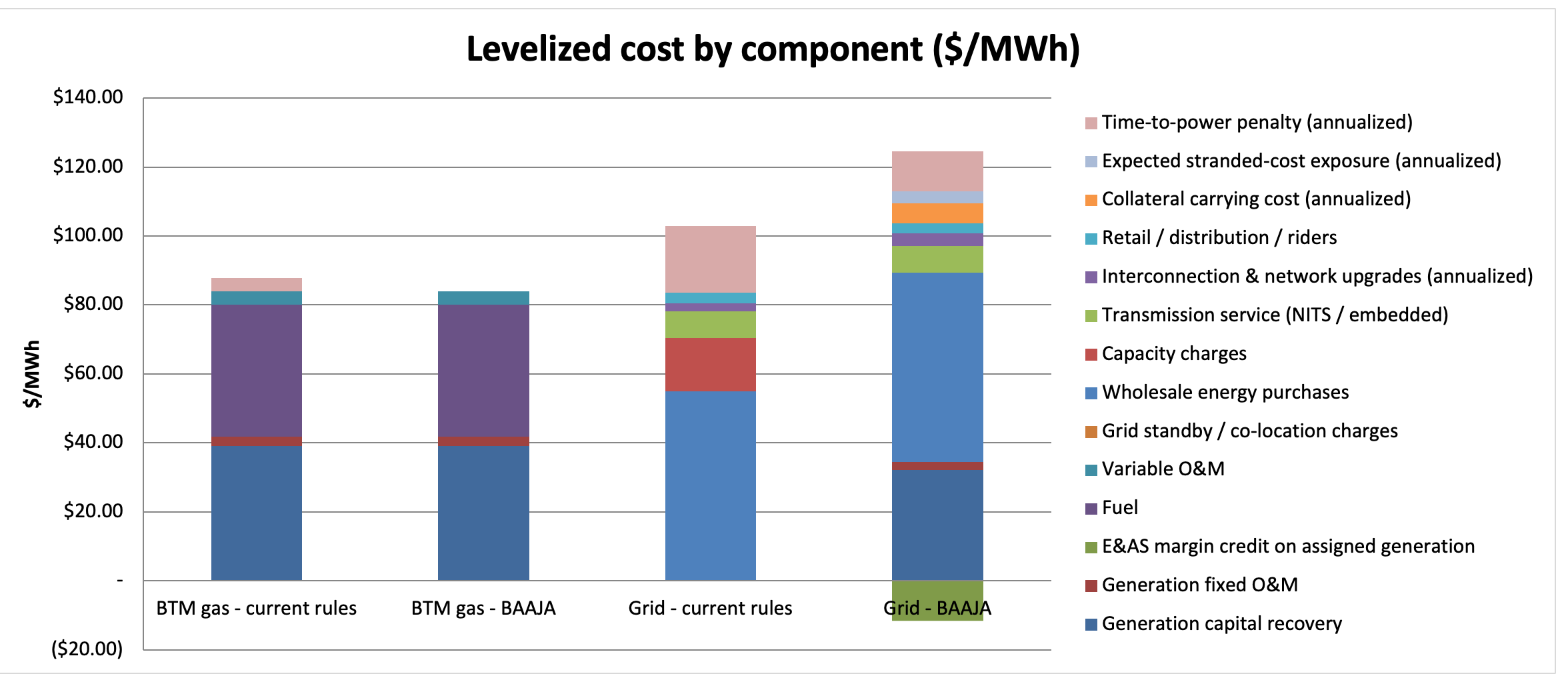
As the chart shows, the primary culprits for the relative increase in grid cost are the time-to-power penalty (smaller under BAAJA but still larger than behind-the-meter) and the generation capital recovery (“pay their full freight” requirement). I note that I’ve assumed away the short time-to-power penalty under BAAJA for behind-the-meter to reflect the increased permitting certainty and speed, which critics will undoubtedly note. But even retaining the current time-to-power penalty would still result in a widening cost gap favoring BTM. I know some proponents continue to cite the lower marginal cost of renewables versus the fuel costs involved with a behind-the-meter plant, but I would remind them that capital chases returns, not lowest marginal costs. If the total levelized cost still favors BTM, even if the marginal cost of the generating technology is higher, then that is still what data centers and their investors will pursue.
All this is to say: BAAJA suffers a fundamental flaw when it comes to data centers: it wants to protect other consumers from spiking rates due to data center clean grid connections, but doing so inherently can make data center grid connections more costly than behind-the-meter gas plants with emissions. On top of this, it simultaneously trades off making natural gas pipeline permitting easier for data centers.
What might this mean for emissions?
I’m not a climate scientist; I’m an economist. I don’t model emissions; I model costs and think about incentive structures. The main takeaway of this post, as I see it, is to note that I think these incentive structures are currently absent from the emissions modeling. Behind-the-meter gas generation represents a huge potential source of new emissions that threaten to unravel all of the progress the U.S. has made toward net zero. Moving more data centers onto a cleaner grid while protecting ratepayers are good goals, but BAAJA falls short of meeting these, primarily by potentially simultaneously reducing the cost and time of behind-the-meter gas power as a part of the grand compromise.
If BAAJA fails to incentivize data centers to move toward the grid while simultaneously accidentally further incentivizing them to continue behind-the-meter gas buildouts, then BAAJA runs a serious risk of failing to lower emissions on net in the U.S. Right now, I’m not seeing this incentive structure reflected in much of the climate modeling, which I think is a big assumption by those modelers and a critical economic reality to overlook.
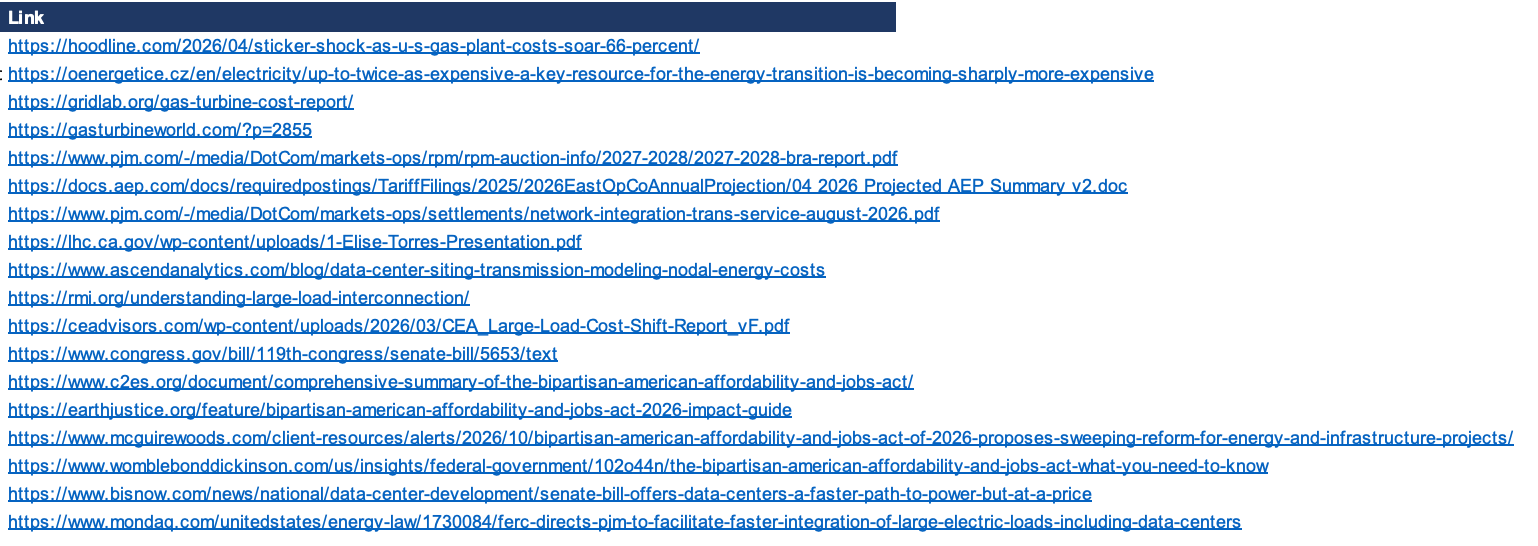
Full list of sources used for inputs in modeling:
U.S. Energy Information Administration. (2026, August 26). Electric power monthly: With data for June 2026. https://www.eia.gov/electricity/monthly/
Mackenzie, A. (2026, October 12). How the permitting deal works. Institute for Progress. https://ifp.org/how-the-permitting-deal-works/
Chediak, M., Dlouhy, J. A., & Natter, A. (2026, October 28). Wind projects become bargaining chip in Trump’s permitting push. Bloomberg. https://www.bloomberg.com/news/articles/2026-10-28/trump-s-permitting-bill-pus-puts-wind-projects-in-the-middle
Martos, J. (2026, August). U.S. gas power proposals tied to data centers nearly double in six months [Report]. Global Energy Monitor. https://globalenergymonitor.org/research/us-gas-power-proposals-tied-data-centers-nearly-double-six-months
Pontecorvo, E. (2026, August 25). The U.S. is building natural gas power twice as fast as China. Heatmap News. https://heatmap.news/energy/10-biggest-gas-plants
Anzulewicz, J. (2026, March 27). Data center time to power: How campuses speed AI deployment. Hanwha Data Centers. https://www.hanwhadatacenters.com/blog/data-center-time-to-power-how-campuses-speed-ai-deployment/