


At a dinner hosted by President Trump last Thursday, over 30 of America’s biggest tech leaders took turns giving praise to the President. One leader’s remarks stood out and grabbed headlines, though. After being asked by the President about Meta’s data center investments in the U.S., CEO Mark Zuckerberg responded, “Um, I’d say at least $600 billion by ‘28.” He was then picked up on a hot mic [video] immediately after, when he turned and leaned toward Trump before saying, “I’m sorry, I wasn’t ready to do [inaudible]. I wasn’t sure what number you wanted to go with.” Trump chuckled before responding, “That’s a big number.”
Trump is right; $600 billion is indeed a very big number. And announcing massive, impressive investments into U.S. tech facilities is all the rage in Silicon Valley and on Wall Street. Emboldened by the widespread adoption of artificial intelligence (AI), all of the big players — Apple, Google, Intel, Amazon, Meta, Microsoft, and OpenAI—have lined up PR for huge promises to construct data centers and tech manufacturing sites across the country. Many of these are accompanied by large public tax incentives and subsidy packages. Zuckerberg’s own comments were reminiscent of another massive surprise investment promise when Trump announced a $500 billion joint AI investment project between OpenAI, Softbank, and Oracle on the day after his inauguration. Almost nine months later, that venture, called Stargate, has so far launched a site in Abilene, Texas, for which it has secured roughly $15 billion in funding — only about 3% of its total announced investment.
That’s not to say companies aren’t spending at all. In 2024, big tech companies spent roughly $180 billion on data center construction. This investment comes with good reason: the demand for data center services remains high relative to supply, which is driving rent costs up and hamstringing growth right as companies are in a race to dominate the relatively new markets for AI. The map below uses announcement data directly from four of America’s largest technology service companies (Amazon, Google, Meta, and OpenAI (Stargate)) to illustrate recent major data center announcements that have occurred just since the start of 2024.
The data for this map comes directly from the four major companies’ PR announcement pages and only includes projects for which the companies published announcements during 2024 or 2025. (Google and Meta should actually be applauded for maintaining maps of their proposed investments alongside currently operating sites.) The data excludes vague investment promises for which a specific location has not been announced (i.e., it only considers OpenAI’s commitment to be $15 billion rather than $500 billion since, at least publicly, $485 billion remains unfunded or unspecified.)
Altogether, the announcements and groundbreakings in 2024 and 2025 total $131.4 billion in data center investment by these big four companies. Not all of that has actually been spent, since not all of the projects have actually broken ground. This number also doesn’t fully align with the $180 billion industry estimate cited above, probably since a) I don’t include data centers from smaller companies, and b) data center construction takes time, and spending on previously announced projects probably carried into 2024. I’m not aiming to be comprehensive, but am simply trying to underscore that in the prior 2 years alone, there has been a large amount of money promised by tech companies to communities across the country for data center construction. And all of that still pales in comparison to the grandiose announcement Zuckerberg made to Trump at the White House.
A few things I take away here:
I’m not denying that companies are very much pursuing data center expansion and, in many cases, are breaking ground on these sites. There is some justified concern about whether the data center fad could wear out if the AI gold rush stops… well, rushing. This concern has been fueled by reports like one last spring that Amazon was pausing some leasing negotiations, but I see no real evidence (at least yet) to doubt that, in general, these announced data center projects aren’t proceeding.
But most of these announcements used boilerplate PR language. For example, Meta used nearly identical wording promising $800M in investment and 100 jobs for each of its sites in Bowling Green, Aiken, Montgomery, Jeffersonville, Rosemount, and Cheyenne. (See examples below.) Whether or not data centers—which are not labor-intensive to operate once the servers are up and running— actually deliver much in terms of permanent job creation and income for local residents is very much up for debate. Their net economic benefit is especially in question if, like in my home state of Ohio, they get public subsidies from taxpayers.
Alas, that’s an analysis for a future post. At a minimum, I think Meta’s PR folks are being somewhat lazy here, and the announcements imply that Meta didn’t bother to conduct unique economic impact studies for each community, which differ in their regional and local economic conditions.
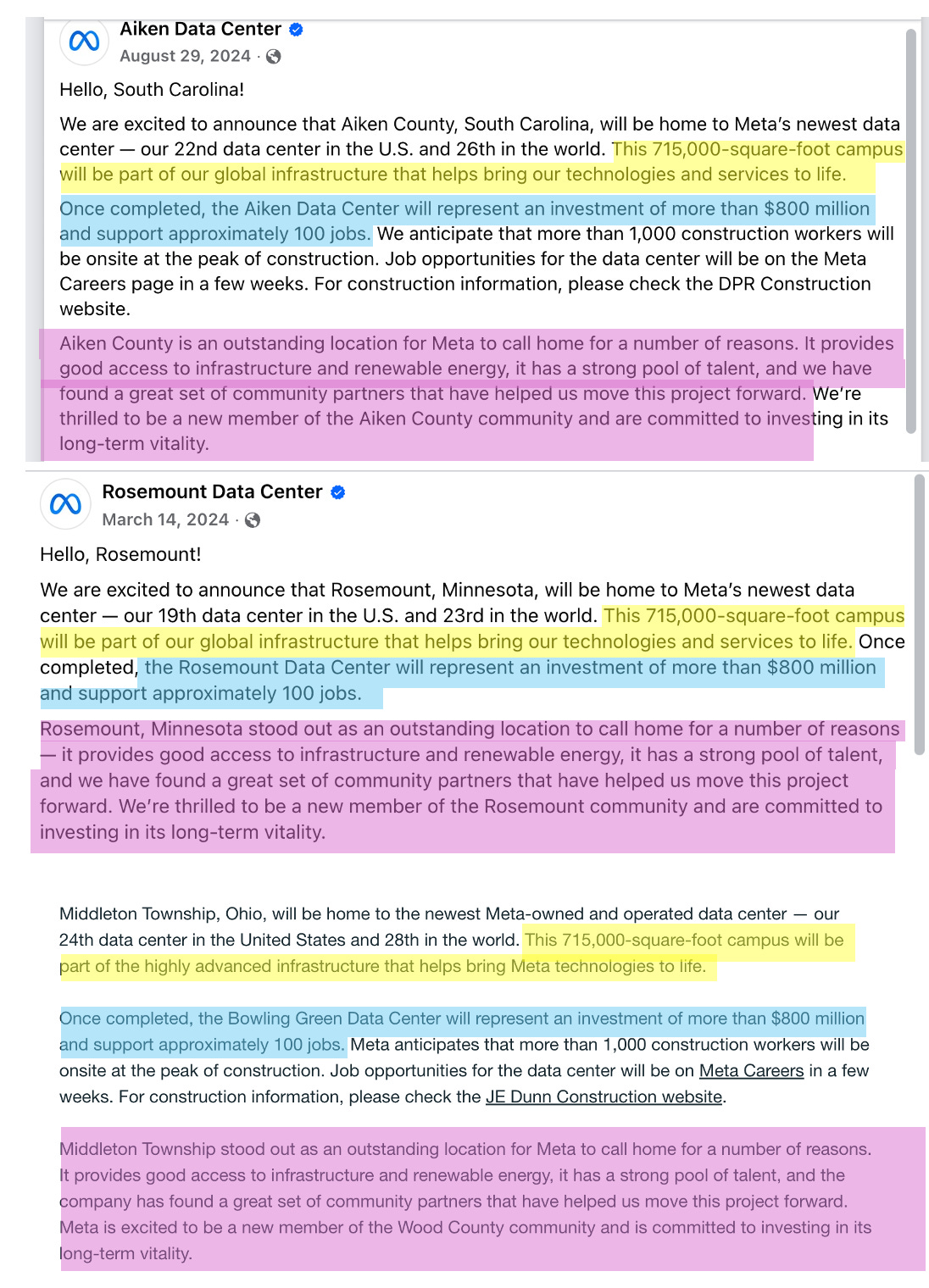
. Meta’s PR announcements for the Aiken, SC, Rosemount, MN, and Bowling Green, OH data center projects utilize the same economic development impact numbers despite regional & local economic differences and use nearly identical language. Source: Meta And the final takeaway…
Zuckerberg’s spontaneous promise to Trump that Meta is investing $600 billion by 2028 is absolutely bonkers.
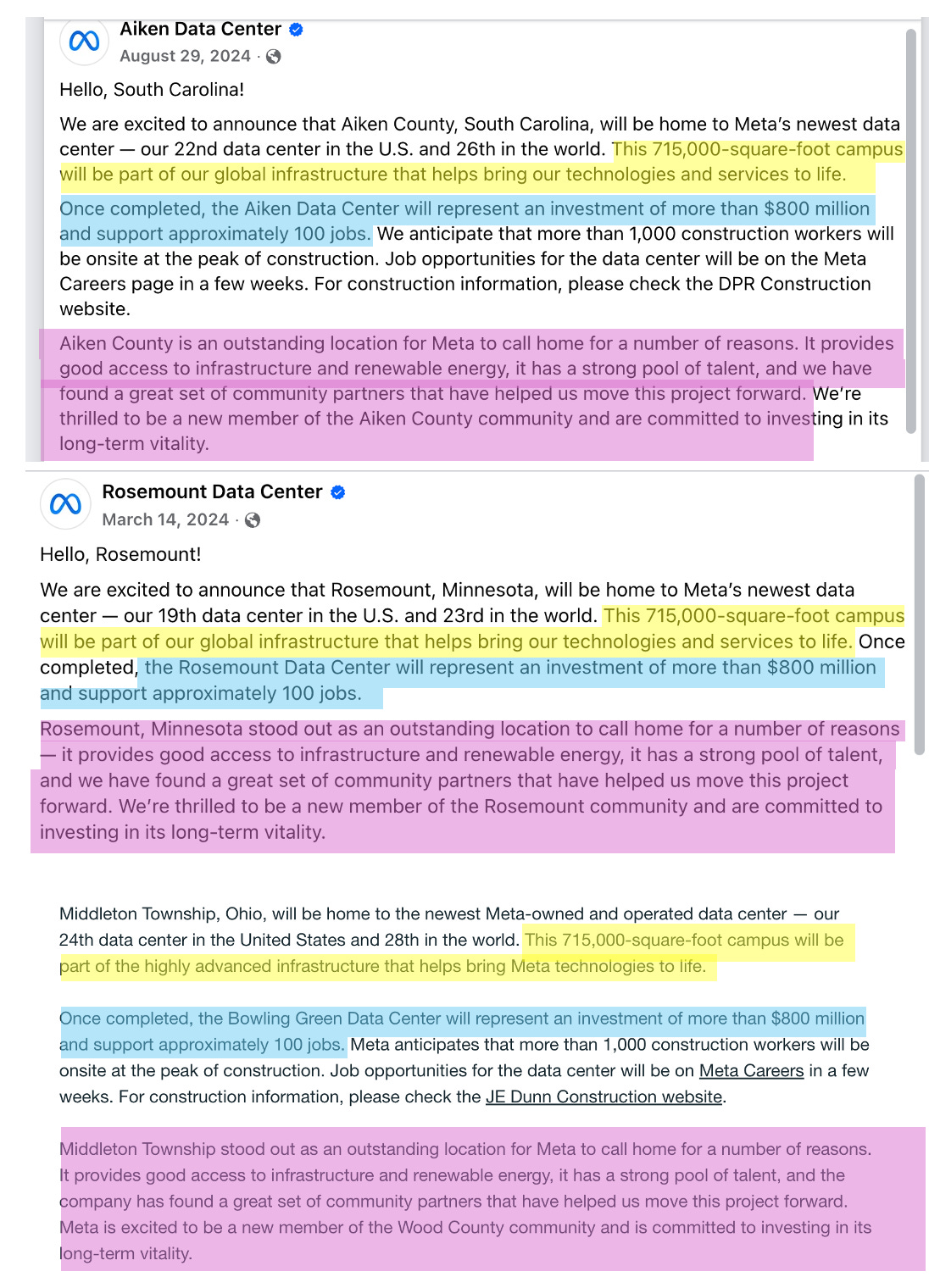
Let’s dig in on #3.
I’m not calling Zuckerberg a complete liar. I do believe Meta is increasing its investment in data centers. It would be corporate malpractice for one of the nation’s largest technology and social media companies to NOT increase its access to AI server capacity. But I think putting an unrealistically aggressive timeline of 24 months on that investment (which coincidentally falls before the next presidential election) is where the hot mic promise starts to become an unbelievable statement aimed at an audience of one in the White House.
A $600 billion investment by just Meta in the next 2 years would be an increase of over 330% of the total announced and sited data center investment by America’s four flagship tech service companies in 2024 and 2025. Using the average investment of $5.7 billion per project from the map data above, Zuckerberg’s announcement would mean 105 new data center projects in the next 2 years. In 2024 and 2025, the four companies combined to publicly announce 22 projects, and Meta itself features 7 investments on its spotlight newsfeed. This would mean that Meta is planning to make a ~1500% increase in the next 24 months over what it announced in the prior 21 months, assuming each site carried at least that average datacenter project cost.
The promise is just too large, too fast to be believable. Most of us are not Silicon Valley CEOs and are used to thinking in hundreds or thousands of dollars; that makes the scale of these economic development promises hard to really fathom. To put the promise in context, $600 billion would make Meta’s data center announcement the 15th-largest state economy in the country by GDP, sitting between Michigan ($706 billion) and Colorado ($553 billion). GDP measures the final value of all goods and services produced in the state for an entire year. In other words, the Zuckerberg off-the-cuff statement means that in the next 24 months, Meta will invest more money into data centers than all of the workers and companies in 35 other states each produce in a year — which, it’s worth repeating, would also be a 330% increase in the total spent by all of the big tech companies on data centers in the past 21 months.
We’ll have to wait and see whether Meta delivers on this massive investment promise in the next 2 years or whether Zuckerberg’s hot mic statement gets walked back. Personally, I chalk it up to another CEO wanting to announce another impressive, giant round investment commitment for good PR and political favor. The proof will be if the rubber — and money — ever actually meets the road.