


“Honey, I think I found the right place for us to move for your new job in D.C.”
“Really? Where?”
“There are some really nice neighborhoods with big houses in Loudoun County. Ashburn has a Metro station into D.C. for you to get to work, and there are great schools and parks for the kids. And the county has actually been one of the ten wealthiest in America since the 1990s! It’s a really nice area.”
“Hmm. Really? I’m not sure. There are other good suburbs with lots of data centers for the kids just outside of D.C., though.”
“That’s the best part! Loudoun has the 3rd most data centers per person of any county in the U.S. And thanks to that, even though our property taxes would be higher, they have come down some!”
The above is an obviously fictitious and hyperbolic conversation between a couple considering whether or not they should move to Loudoun County, Virginia, which has become the key example the tech industry points to illustrate the purported economic benefits of AI data center development.
By using Loudoun as an example, data center advocates implicitly hope to either convince people that places become more desirable the more data centers they have or convince people that smaller communities around the country can somehow afford to build the luxury amenities found in places like Loudoun County while simultaneously giving tax breaks to the data centers.
Because the first suggestion is preposterous, as illustrated by my fictional conversation between parents, this piece focuses on the second implication: the false premise that rural communities can achieve the same economic success as Washington, D.C.’s richest suburbs while simultaneously being asked to give data centers special tax breaks.
Data center proponents always set an idyllic scene for the Loudoun County argument, painting Washington, D.C.’s richest suburb as if it were quite recently a sparsely populated Wyoming ranch town until the AI data centers arrived to modernize it. The right-wing City Journal published a piece this year describing Loudoun County as “until recently, a rural outpost of D.C.,” which I suppose is true if you consider a county that had over a quarter million residents two decades ago to be “recently rural.”
For what it’s worth, thirty-three years ago in 1993, the U.S. Department of Agriculture’s Rural-Urban Continuum assigned Loudoun County a “1” out of a possible 9, which is reserved for counties that were part of the highest possible population metropolitan areas. For some context, Pike County, Ohio, where one of the world’s biggest data centers is currently planned, was assigned a “7” in the same year, which classified it as actually rural. And even “just” 20 years ago, Pike County had 28,146 residents, making it almost nine times smaller than Loudoun County in 2005.
Loudoun County, as we can see, has long been part of the D.C. metro area. While it has rural pockets and was once smaller than other commuter counties, it has never been rural to the same degree as truly rural counties in other parts of the U.S.
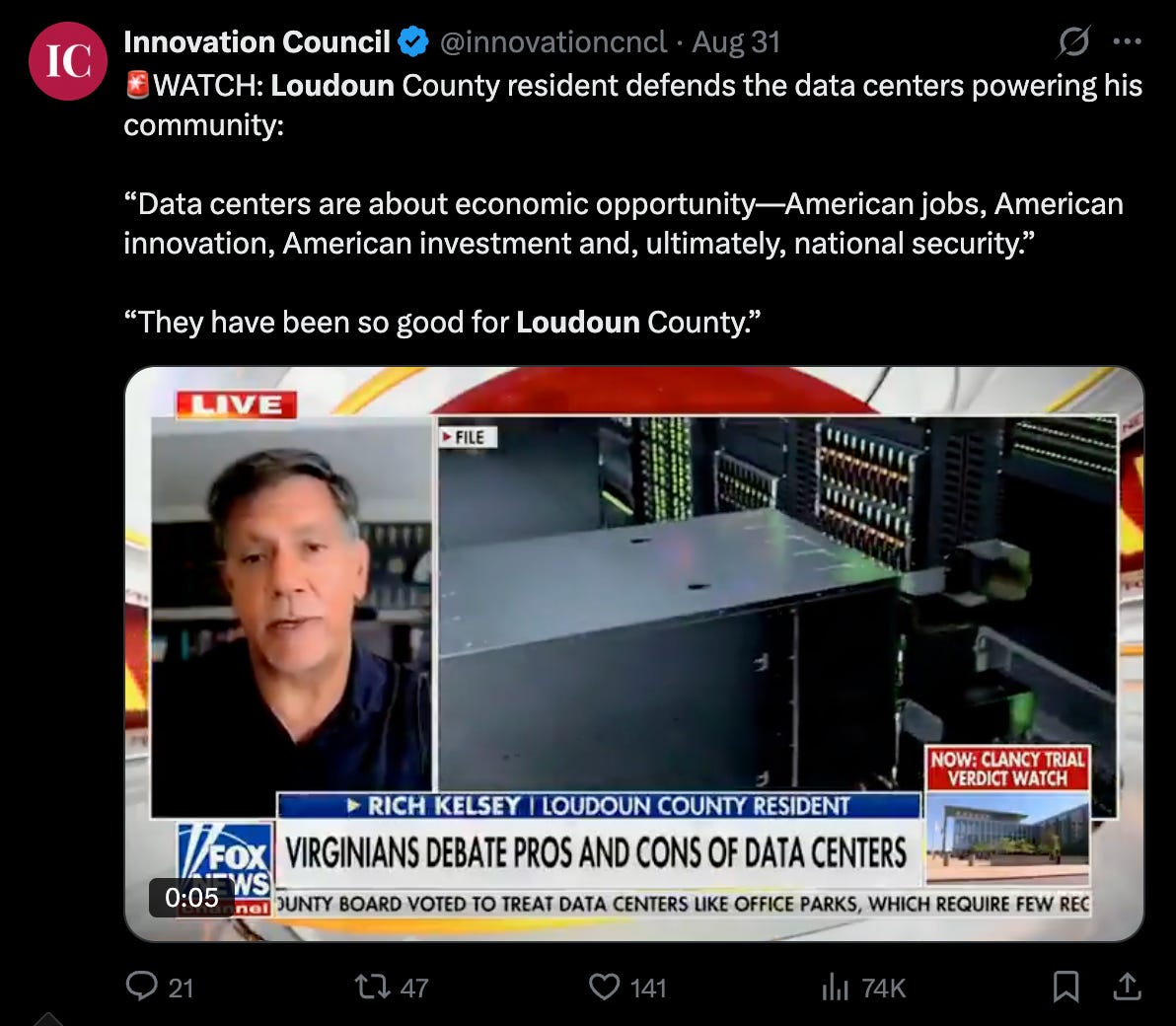
Yet on social media, endless references glorifying Loudoun County’s data center miracle flow from right-wing and pro-tech industry accounts and Fox News interviews. They often cite vague, nationalist platitudes about innovation, jobs, energy, security, and beating China.
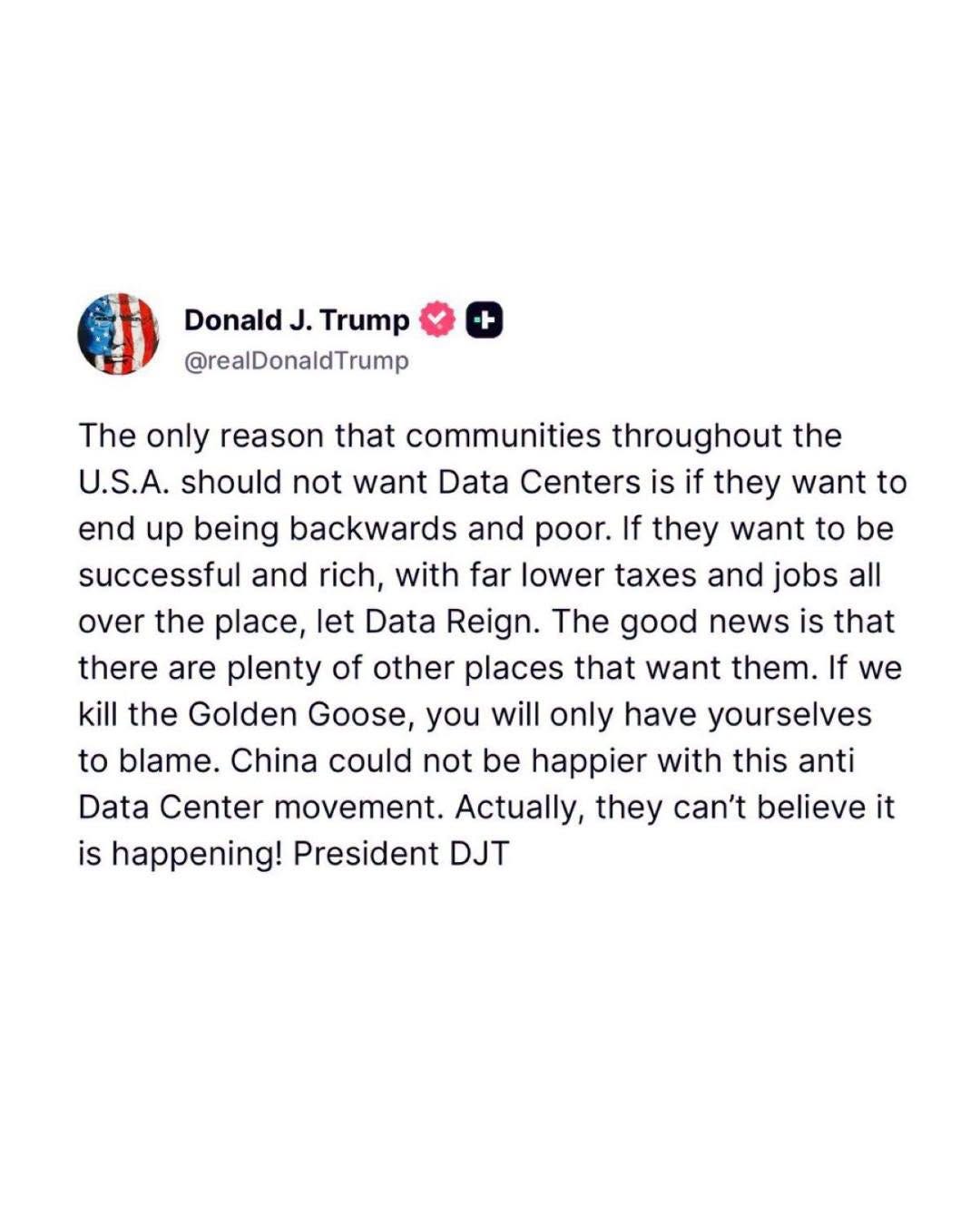
This week, even President Trump posted that communities and Americans who don’t want data centers “want to end up being backwards and poor” and prescribed that they “let Data Reign” if they “want to be successful and rich,” presumably like Loudoun County.
Now, before I continue, I am not an extremist “anti-growth” data center or AI denier. I have written about how complete data center construction moratoriums and bans are cheap political stunts and bad policy. I have also shared my views on what I believe good data center development might look like. There are real-world examples of data center projects that prove some of my suggestions are entirely possible, such as a recent announcement from Frederick County, Maryland, of a data center that will shrink its original size by 20 percent, create a nature preserve, provide $110 million to the community, and, crucially, receive no local tax incentives or special tax breaks.
But people who point to the richest suburb in America and suggest that you, too, can become the wealthiest county in America if you just let the AI companies build data centers in your fields are being dishonest. Let’s walk through it.
Loudoun’s Biggest Job Growth Happened Well Before the AI Hyperscale Boom
First, Loudoun County was growing well before hyperscale AI data centers became a thing. Early data centers in the 1990s and 2000s were to support, well, the early internet. Anyone of an age that can remember receiving an AOL CD in the mail can certainly understand that, like the early internet, early data centers were a far cry from the AI behemoths being built today.
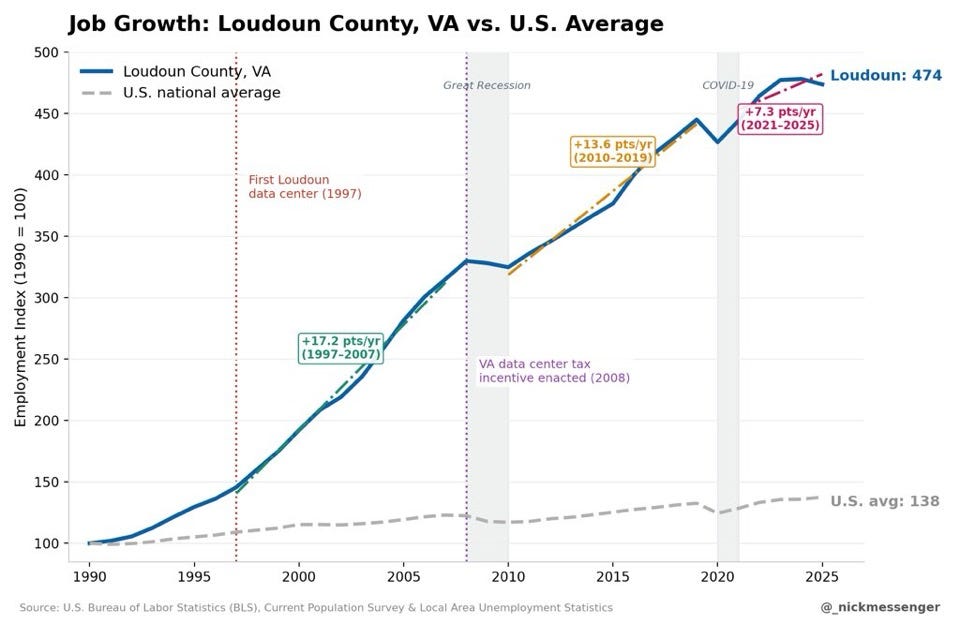
As far as I can tell, the first data center in Loudoun came in 1997. In 2008, Virginia began exempting data center sales and use taxes. In the decade between 1997 and 2008, Loudoun County employment grew rapidly. Maybe it was the early internet data centers? Maybe not? A more robust, peer-reviewed study would be needed to control for other factors (a lot of other things in the D.C. area have also changed since 1997 that could spark growth).
But what is also true is that Loudoun County itself actually grew more slowly after the tax exemptions were created. In the chart above, I exclude 2009 and 2010 from the data, which is actually generous to the pro-data center advocates because I don’t penalize them for the Great Recession. But post-recession from 2010 to 2019, Loudoun grew more slowly than from 1997-2008.
What about since the COVID-19 pandemic? I follow the same logic and exclude 2020-2021 to try to avoid falsely attributing both pandemic job loss and job recovery to data centers. But since 2022 (right before the release of AI in late 2023), Loudoun has grown even more slowly than it did in 2010-2019.
In short, data center evangelicals want you to believe that Loudoun is the AI blueprint for everyone else because it grew really fast 20 years ago, before the iPhone was released. But I would argue that we should look at trends. Loudoun is still growing faster than the U.S. average, sure. It is still extremely wealthy. But compared to itself, the growth has slowed down during the same time period the AI boom has sped up. That’s tough to square.
To the extent that data centers determined Loudoun’s rapid growth path in the late 1990s, the county may have benefited by being what economists call a “first mover.” That means that it got in on the ground floor. Maybe those 1997 data centers helped the county to build the electric and telecommunications infrastructure that made it more attractive to even more tech investment in the following decades. That’s certainly not impossible and probably even likely. But that’s also an impossible feat for smaller and rural counties to replicate. Small towns just can’t get in on the ground floor in 2026 and catch up to a rich suburb of Washington, D.C that has been building this industry for 30+ years.
Resident-based employment measurements have grown faster than in-county employment measures.
This one is a little more in the weeds, but it’s important. There are (broadly speaking) two ways we can measure jobs in the U.S. Economists can measure jobs from the workers’ point of view (who do you work for and where are they located?) using things like surveys or tax returns. Or we measure jobs from the employer’s point of view (where are you located and how many people work for you?)
The federal government does both. Local area unemployment statistics (LAUS) data is residency-based, meaning it counts jobs in the places that workers live. The Quarterly Census of Employment and Wages (QCEW) uses payroll data from companies to count jobs in the places where workers work. We know that many workers, especially in suburbs of large cities, commute across municipal and county lines between home and work, so these two numbers are not always the same.
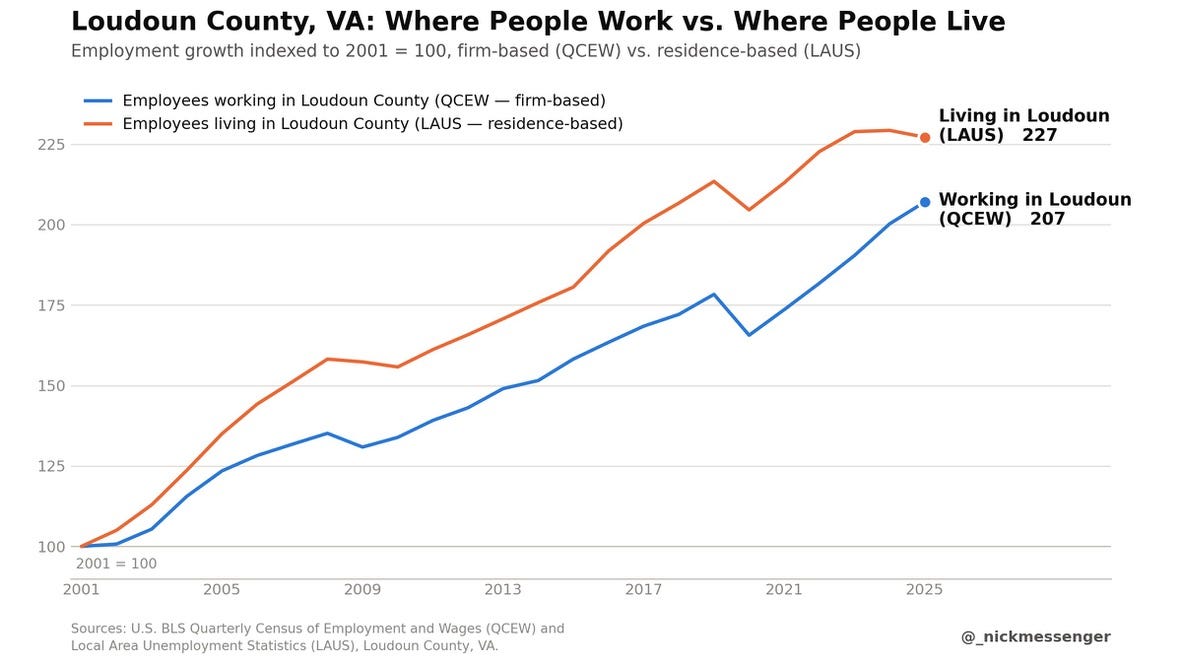
In Loudoun County, residency-based employment has actually grown by an additional 26 percentage points since 2001 compared to in-county jobs. And since data center construction and employment are generally tied to the facility location itself, this could mean that the bigger chunk of Loudoun’s huge economic growth has actually been driven by D.C. commuters, rather than new data center sites in the county.
Property taxes in rural areas are already lower than in Loudoun County.
A favorite claim is that data centers have lowered property taxes for Loudoun County residents. I won’t wade into the math here, and proponents, depending on how they are stating it, are right.
But that’s like saying Jeff Bezos got a deal on his mansion. His concept of “a deal” and the rest of our concept of “a deal” are likely very different. Likewise, Loudoun County residents’ perception of high property taxes and rural residents’ perception of high property taxes are very different.
Comparing property tax rates across state lines is complicated, but even within Virginia, surface-level evidence is pretty clear that rural Virginians already pay a lower property tax rate (on generally lower-value property) than Loudoun residents.
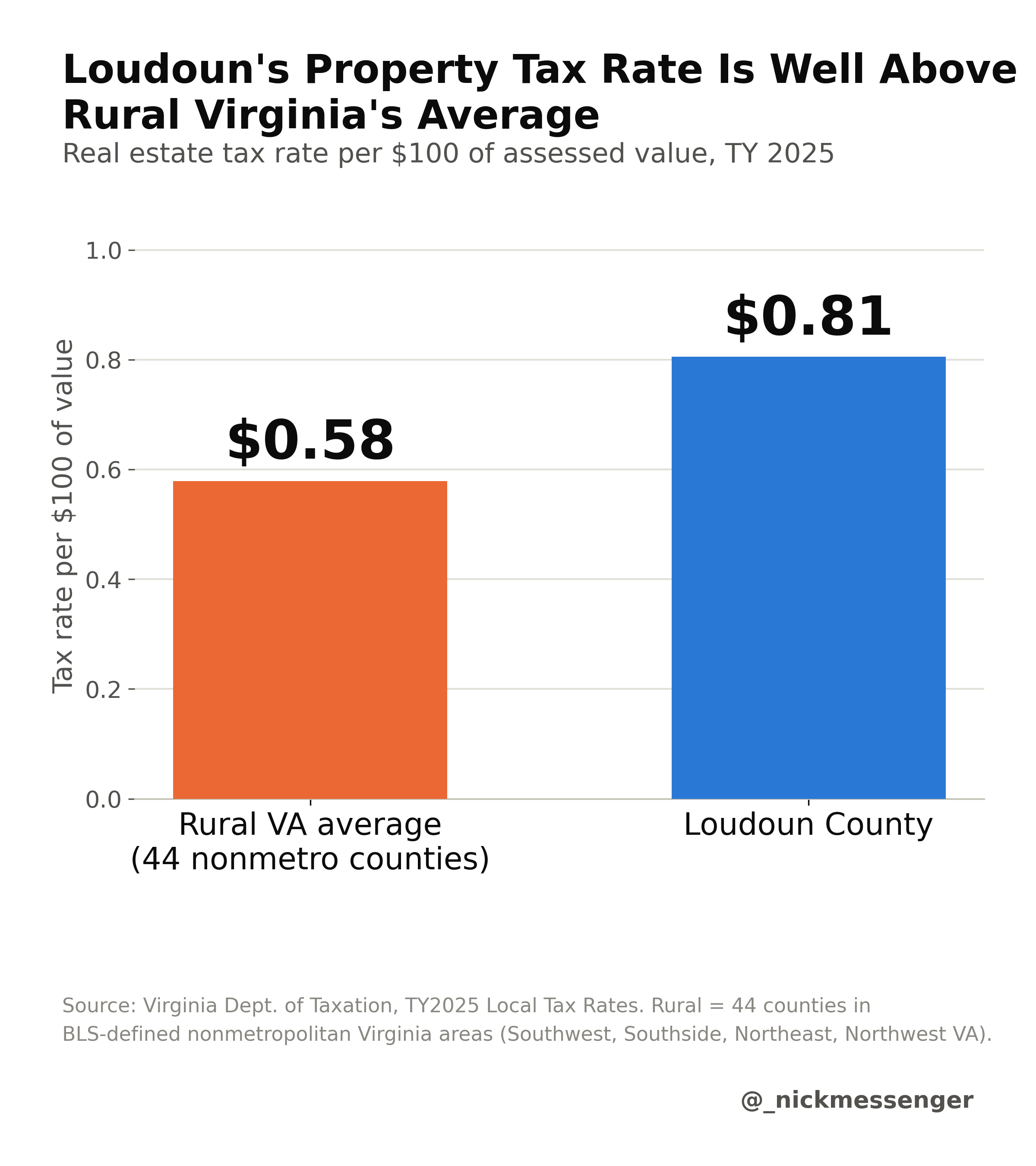
How significant any savings from data centers could be for residents is actually a big outstanding question and will vary place-by-place across the country.
“…there are many ways that AI companies have received hundreds of millions of dollars in property tax breaks for data centers across the country.”
The savings are also highly dependent on whether a data center receives local income tax or property tax breaks. As Good Jobs First explains, there are many ways that AI companies have received hundreds of millions of dollars in property tax breaks for data centers across the country. When a data center receives local tax breaks, it inherently utilizes public resources like roads, sewers, water treatment facilities, waste disposal, fire departments, police and sheriffs, health, and other local government services.
This increased utilization, depending on how big it is, can then require expansion and raise the costs of the service. Except that, because it might not be paying taxes, the data center company doesn’t share in paying those increased costs. The costs can get passed on to the other residents paying taxes in the city, township, and county. Or, sometimes worse, the services don’t have money to expand and their quality drops for everyone else because they now must also serve the data center.
Data centers can exploit smaller communities and have sought billions in tax breaks.
Indeed, much of the reported property tax relief and quality of life improvement for Loudoun residents has come because the county taxes data center development. It is likely able to tax data centers and still have them build in part because of its first-mover infrastructure advantages and proximity to D.C., which is leverage that rural areas of the country simply don’t have.
As the New York Times noted last month, “A tax on computer equipment inside the data centers is expected to generate about $1.3 billion in revenue next year, or 40 percent of the county’s total tax revenue. That has allowed the county to cut property taxes for residents — who have the highest median income in the country — by about 30 percent over the past decade.”
The article goes on to highlight that “Loudoun’s success monetizing data centers runs counter to a nationwide trend in which communities court the computing sites with huge tax incentives, then experience buyer’s remorse as the centers guzzle water and electricity. Data centers typically create few jobs, and little revenue for a community.”
There’s a real difference in how companies interact with small communities that I’ve seen. Loudoun likely possesses local governments that are deeply familiar with the industry, dating back to its early involvement and first-mover advantages. Loudoun is in a position of leverage in negotiations with data centers.
In contrast, many townships and small towns across the country are generally run by less sophisticated, part-time governments with fewer resources and far less leverage when negotiating with Amazon, Meta, and Google lawyers. “Give us a tax break, or we’ll take our money somewhere else that will” is often the entirety of the negotiation. Data center advocates who ignore this reality while simultaneously asking “why don’t you guys want to be like Loudoun!?” are burying their heads in the sand.
Taxation is key to producing community benefits
In my previous piece, I commented on the importance of not providing tax exemptions or breaks to data centers. These policies vary wildly across states and across counties in the U.S. and are likely responsible for the uneven economic results communities experience.
According to the National Conference of State Legislatures, as of late 2025, 38 states had created some sort of data center-specific tax exemption. This is typically a sales tax exemption on the billions of dollars of equipment and expensive chips, such as NVIDIA’s Blackwell and Vera Rubin designs. In 2026, some states began to roll back data center support. These actions ranged from New York’s complete moratorium on hyperscale construction (which I believe is bad policy) to Ohio’s moratorium on new sales tax exemptions for data centers (a good step).
In any event, if data center proponents truly want communities to share in the riches of the data center buildout, then they would also strongly oppose tax breaks for data centers and loudly support and empower local communities to increase their taxation of data centers, similar to what Loudoun County has done. If tech advocates and investors were serious about wanting the benefits to spread, they would demand that AI companies build in rural areas and pay their full freight, without special tax breaks. They would work to help local communities obtain more control and leverage, instead of blaming them for their economic disparities with D.C.’s richest suburb. If data center advocates and companies did that, then maybe data center development could actually begin to bring widespread shared prosperity to more communities across the country.
Until then, data centers seem like more of the same for small communities: a lofty promise from a big corporation of more jobs and incomes in the future in exchange for special tax breaks now. Communities have been let down by those same promises from other industries for decades. It is incumbent on the AI industry to explain why this time will be different.